Part 3
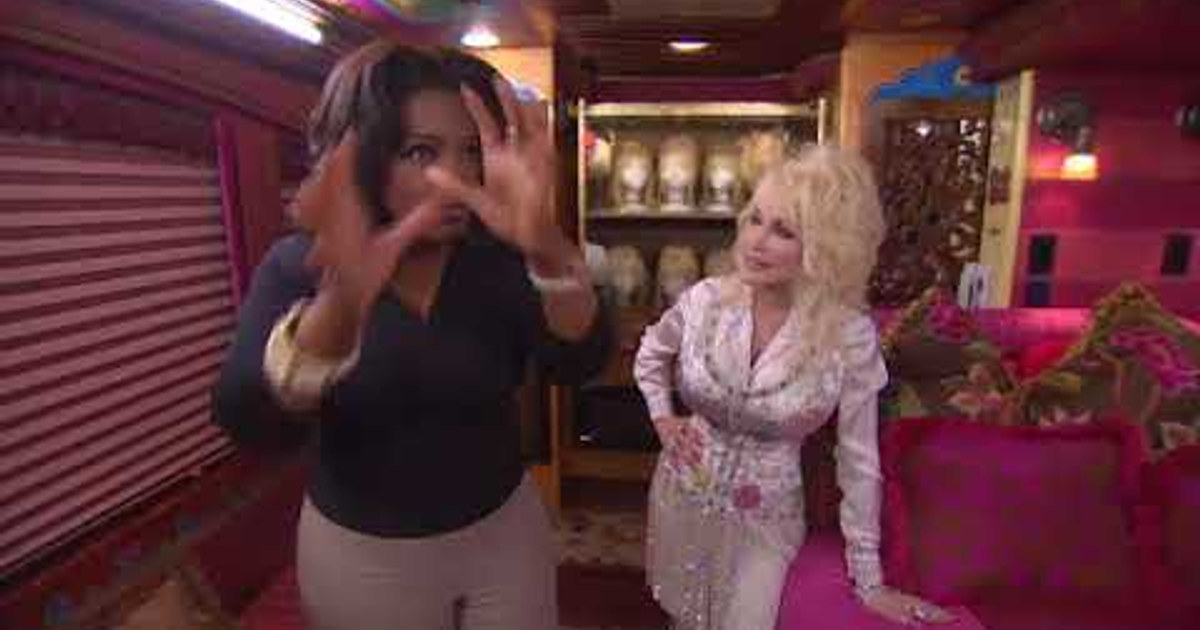
Production design as engineering. The fold-out prayer station that stows into a box. The cosmetic station with the absurdly small chair, which reads as a scale gag and a staging solution at once. The shelves that hold wigs and a cross in the same run of real estate. Every object has a job. The prayer station folds. The chair is small because Dolly is small, but it's also small because a normal chair wouldn't fit in the aisle. The wigs need shelf space; the cross needs a place to sit. They share the same shelf because the shelf is the budget. That's not decoration. That's logistics. A lesser tour segment would show you the wigs and stop. This one shows you the wigs and the cross, and lets you do the math.
Talk props as payoff. A cross used as a bookmark is a small object that does narrative work: it tells you about reading habits, faith, and thrift in one gesture. The host says she has one just like it, and she uses hers as a bookmark. That's a character beat, a cultural signal, and a production detail in a single line. A good tour segment budgets for one prop per beat and spends it. The cross is spent. The quiche is spent. The tiny chair is spent. Nothing is wasted.
The food inventory as a rules engine. Mozzarella, pepper jack, a quiche with a pork-rind crust, turkey, ice cream on board, low-carb through the week and "what I want" on the weekend. Frame it as configuration with an exception list — the most programmer-honest paragraph in the piece. You have a base state: low-carb. You have allowed exceptions: the weekend. You have a caching layer: the ice cream. You have a sister, Rachel, who maintains the inventory. This is not a fridge. This is a deployment pipeline.
Editing rhythm: how these segments are cut on openings rather than on dialogue. Doors, drawers, lids, a shower curtain, a folding table. Each open is a beat, and the cut lands on the reveal. It's the same economy you see in single-location films. Rope (1948, directed by Alfred Hitchcock, 80 minutes) uses long takes to make a single apartment feel like a pressure cooker — the cuts are hidden, but the tension is in the blocking. My Dinner with Andre (1981, directed by Louis Malle, 110 minutes) is two men at a table, and it never runs out of visual interest because the blocking is the edit. Buried (2010, directed by Rodrigo Cortés, 95 minutes) traps Ryan Reynolds in a coffin and finds a hundred shots by cutting on the flashlight, the phone, the lighter. The Trip (2010, directed by Michael Winterbottom, 107 minutes) is two comedians in restaurants, and the cuts land on bites and reactions. Chef (2014, directed by Jon Favreau, 114 minutes) turns a food truck into a moving kitchen and cuts on the sizzle, the chop, the plating. The bus segment belongs to that lineage. The bus is the single location. The opens are the cuts. The reveals are the payoff. It's editing as engineering.
The verite contract, stated dryly: nothing here is fake, and nothing here is accidental. That's a tough line to walk. Compare the designed-unscripted tension of The Rehearsal (HBO, 2022), where Nathan Fielder builds elaborate sets to simulate reality and then lets reality leak in. Or the long-running arguments about staging on MTV Cribs (MTV, 2000–present), where celebrities gave tours of mansions that sometimes felt suspiciously well-lit. The bus segment sits in that space. It's a real bus. Dolly really lives on it. But the camera positions, the cut points, the reveals — those are chosen. The verite is a style, not a lack of craft.
Land the section on the thesis sentence: this is a machine built to remove hotel check-ins, and a set built to look like it was never designed at all. Engineering with a soul, parked at the curb. That's the dual appeal. The genre viewer sees a cozy home on wheels. The craft viewer sees a rig that solves a dozen problems at once. Both are right. And both are watching the same bus.
[[AD]]
Why the Wigs and the Wiring Are the Same Story
Here’s the payoff the opening promised. The genre viewer and the craft viewer are not watching two different things. They are watching one system. A person engineered a life so it could travel, then dressed the result so it would feel like home. The wigs and the wiring are the same story.
Return to the line that should be framed and hung in every production office: “I don’t ever check in hotels anymore.” Read it once as a star-power flex. Read it again as a design brief. The bus exists because the checklist of work, dressing, reading, and prayer had to happen somewhere that wasn’t a lobby. That’s not vanity. That’s requirements gathering.
Take the prayer altar and the wigs as a single shelving unit rather than a contradiction. A chapel in every house, a fold-out altar on the road, and a cosmetic station two feet away is not irony. It is inventory. Sacred and showbiz are two SKUs on the same shelf. The bus is the warehouse that keeps both in stock.
The host earns her due as a craftsperson here. Her counter-detail — a prayer chair at home where the sun comes up, and a cross she uses as a bookmark — is mirroring used as a tool. You offer a small true thing to get a bigger true thing back. That is interview engineering. It is also why the segment feels like a conversation instead of a tour.


