Part 3
The kitchen is where the theology gets practical. Dolly is low-carb through the week — quiche with a pork rind crust, mozzarella, pepper jack, turkey — and then she eats what she wants on the weekend. Ice cream is on board at all times. “So when I do fall off my diet,” she says, and laughs. Her sister Rachel manages the crew, the meals, the whole rolling household. It’s a family operation, which is another way of saying it’s a trust operation. You don’t hand your daily bread to strangers. You hand it to blood.
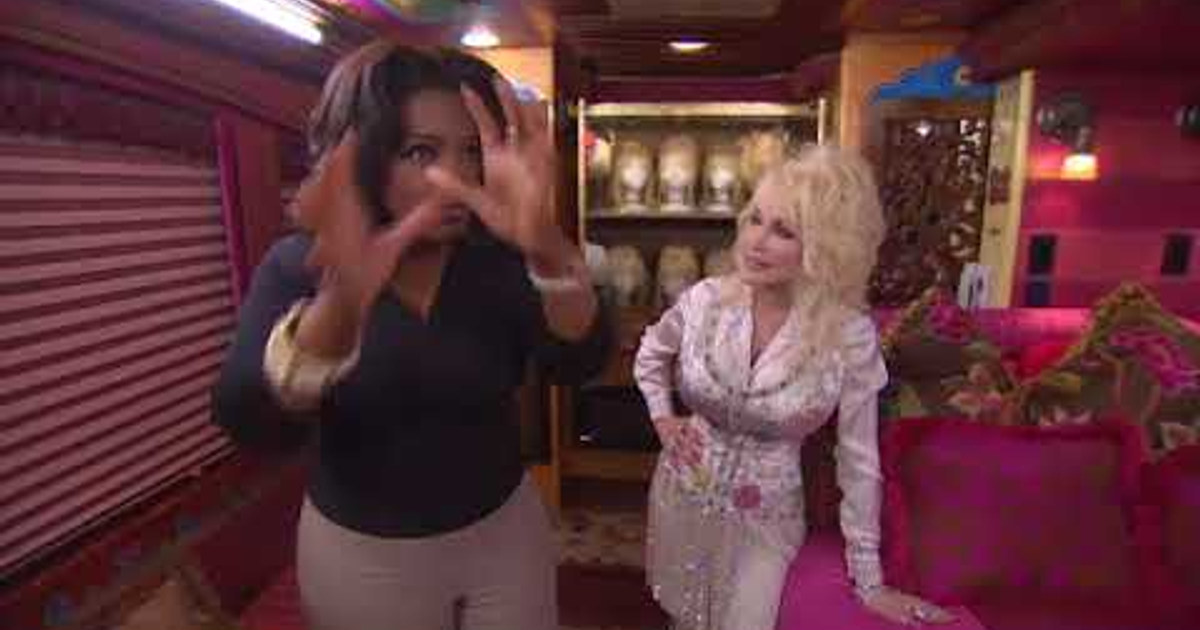
And here’s the line that lands like a door closing: “I don’t ever check in hotels anymore.” She says it plainly, without bragging. But think about what it means. Dolly Parton — the most famous woman in country music, a cultural force since the late 1960s — has decided that the world can come to her. She doesn’t need a penthouse suite. She has a home that travels. She doesn’t need room service. She has Rachel. She doesn’t need a lobby. She has a prayer altar and a bowl of tomatoes and a bed where she does all her reading, all her dressing, all her living. “I live on my bed,” she says. And you believe her. The bus is not a compromise. It’s a choice.
[[VIDEO]]
To understand why that choice matters, you have to understand what fame does to a person’s geography. Dolly left Nashville for Hollywood in the 1980s, the same decade she opened Dollywood in 1986. She starred in 9 to 5 in 1980 — a film that turned the office into a battlefield and made her an instant movie star — and then in The Best Little Whorehouse in Texas in 1982, and Steel Magnolias in 1989. She built a theme park. She built a production company. She built an empire. And at every step, she was surrounded by people who wanted a piece of her time, her image, her voice. The bus is her answer to that chaos. It’s the smallest world she’s ever built, and the most personal. It’s the one place where she is not Dolly the brand. She is just Dolly, sitting on her bed, praying, eating quiche, trying on wigs.
The working-class roots show. Dolly grew up poor in the Smoky Mountains, one of twelve children, in a house with no electricity. She knows what it is to have nothing. So when she builds a bus that costs more than most houses, she doesn’t fill it with marble and chandeliers. She fills it with practicality. A tiny tub she can actually use. A kitchen that makes food she actually eats. A prayer altar that actually folds out. This is luxury as utility. It’s the opposite of ostentation. It’s a woman who has been rich for decades and still measures comfort in terms of what fits her body and her soul.
That’s why the bus feels like a masterclass. Not in decorating — though it is beautiful — but in living. Dolly has figured out something most of us never do: that a home is not a place. It’s a set of rituals. It’s the tomatoes you keep on the counter. It’s the chair you kneel at. It’s the sister who runs the kitchen. It’s the wigs you call goodies. The bus is just the container. The life is what she puts inside it.
And when she says, “I’d love to take you on a trip sometime,” you realize she’s not just being polite. She’s inviting you into her world. The one she built. The one that moves. The one where the sun comes up through the windshield and the prayer altar is always within reach. She’s been waiting since 4 a.m. for you to see it. And now you have.
The Invitation: 'I'd Love to Take You on a Trip Sometime'
The bus is still parked outside Harpo Studios. It has been there since four in the morning, a long silver vessel breathing quietly in the Chicago dark, and now we know what it holds. Not a dressing room. Not a flex. A home. A tiny tub you can sit in because you are small enough to sit in it. Tomatoes sent from Los Angeles in the middle of a Nashville winter. A little chair pulled up to a little cosmetic table. A prayer altar that folds into a box when the wheels start turning. And a woman standing in the middle of it all, saying the thing that makes the whole tour make sense: 'Well, I'd love to take you on a trip someday.'
That's the payoff. Not a plug for an album. Not a wink at the camera. An invitation. The kind you give a friend. The kind that assumes the road is better shared.
Dolly Parton has been issuing that invitation for almost sixty years. In 1967, she stepped onto The Porter Wagoner Show, a syndicated country music variety series that reached millions of living rooms across the South and Midwest. She was twenty-one. She wore her own clothes, sang her own songs, and let strangers watch her become a star in real time. That was an invitation: come watch me grow. Viewers accepted. They stayed for seven years, until she left the show in 1974 to build something of her own.
That same year, she released 'Jolene.' A song about a woman begging another woman not to take her man. Simple. Devastating. Number one on the country charts. And an invitation of a different kind: come feel this. Come stand in this fear and this longing and this strange, generous vulnerability. Millions came. They're still coming. 'Jolene' has been covered by everyone from The White Stripes to Miley Cyrus, and in 2023, Dolly re-recorded it for her rock album Rockstar, a record that debuted at number one on the Billboard 200 and featured Paul McCartney, Ringo Starr, Elton John, and Lizzo. She was seventy-seven. The invitation still worked.


