Part 2
Then the refrigerator. “I cook,” she says. “Or I’m on low carb right now.” Her sister Rachel takes care of the food, and the crew is wonderful, and there is quiche with a pork rind crust, and mozzarella, and pepper jack, and turkey, and ice cream for when she falls off the diet on the weekend. She never checks into hotels anymore. Why would she? The bus has a bathroom, a kitchen, a bed, a prayer altar, and a door that closes. She has built a life that does not require her to leave it.
This is the masterclass. Not the career—though the career is unmatched, from The Porter Wagoner Show to 9 to 5 to Steel Magnolias to Rockstar. The masterclass is the bus. It is the decision to make the small space the grand one. It is the refusal to separate the sacred from the silly, the prayer altar from the wig wall, the pork rinds from the quiche. It is the belief that a home is not a place you return to but a place you carry, and that if you build it right, you never have to check in anywhere again.
The bus has been waiting since 4 a.m. But really, it has been waiting for decades. It waited through Porter Wagoner. It waited through 9 to 5. It waited through Steel Magnolias and through every award show and every album and every interview. It waited for the moment when Dolly Parton would open the door and say “Hey, girl” to someone who had never traveled by bus, and then show her that the bus was never the point. The point was the life inside it.
And then, at the end of the tour, standing in the narrow aisle between the tiny chair and the tiny tub, she says it: “I’d love to take you on a trip someday.” It is not a line. It is an invitation. The bus is still parked outside Harpo Studios. The engine is still off. But the door is open, and the tomatoes are fresh, and the world is small enough to fit inside a moving home—if you know how to pack it.
A Double Wide on Wheels: Inside Dolly's Rolling Home
The first thing you notice is the light. It comes through the windows in long, amber bars that fall across the floor like a welcome mat. Then you see the tomatoes. A bowl of them, fat and red, sitting on the counter as if they’d just been picked from a garden that happens to be doing seventy down the interstate. Dolly keeps them coming from Los Angeles all winter, she says, and you can take one on your way out. It’s a small thing, a bowl of tomatoes. But it tells you everything about the way she lives: nothing is an afterthought. Not the fruit. Not the furniture. Not the faith.
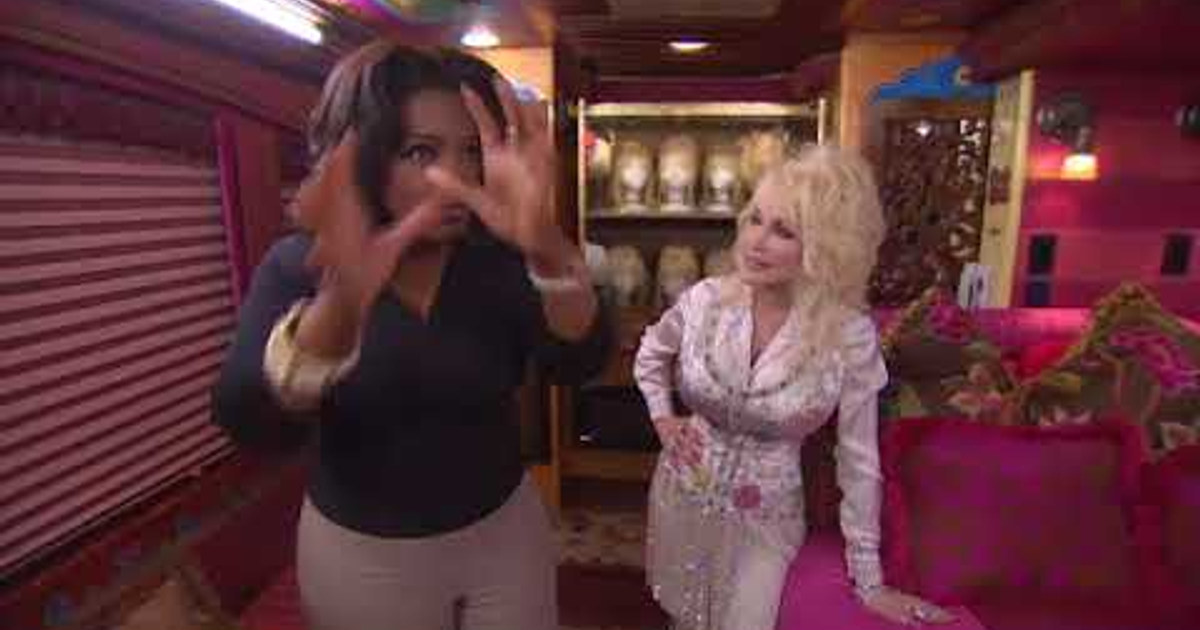
This is not a bus. It’s a double wide on wheels, as the host puts it, and she’s not wrong. The walls are cream and gold, the upholstery is soft as a hymn, and every surface seems to have been chosen for the way it holds a person. Dolly stands five feet tall in her bare feet — she’s said so herself — and the entire vehicle has been scaled to her. The chairs are little. The counters are low. The world outside may be built for six-footers, but in here, she is the measure of all things. It’s a design principle, not a quirk. When you are small, you learn early that the world will not shrink for you. So you build your own.
She leads the way past three bunks, tucked like drawers into the wall. The drivers sleep there, usually a couple of them, because the bus doesn’t stop just because the sun goes down. Then she opens the door to her own room — her own little bathroom, she calls it, with a shower so small she can sit right down in it. “You cannot sit in that tub,” the host says, laughing. “I do all the time,” Dolly shoots back. “It’s a little teeny tiny baby tub.” There is no defensiveness in her voice. Only delight. She has made peace with scale. She has turned it into a kind of luxury.
[[AD]]
The wigs come next. “Come here,” she says. “I’ll show you all of my goodies.” And there they are, row after row, a rainbow of them, each one a character waiting for its cue. She doesn’t call them wigs. She calls them goodies, which is exactly what they are — treats, treasures, tools of the trade. This is the cosmetic area, with its little mirror and its little chairs, and it’s here that the Dolly we see on stage gets assembled, piece by piece, like a doll being dressed for a very important day. She’s been doing this since she was a girl in Sevierville, Tennessee, dreaming of Nashville. The wigs are not vanity. They are armor. They are art.
But the most sacred corner of the bus is not the mirror. It’s the prayer altar. A fold-out shelf, a little box for her things, a place to kneel if the spirit moves her. She tells the host she has chapels in all her houses. “I do it everywhere,” she says. It’s not eccentricity. It’s architecture. Faith isn’t something she does on Sundays; it’s something she builds into the floor plan. The host mentions her own prayer chair at home, the one she goes to in the morning, where the sun comes up. Dolly nods. She understands. A place to pray is a place to be human. And when you live on a bus that never stops moving, you need a fixed point. Even if that point folds up into the wall when you’re done.


