Part 1
Two Kinds of Viewers Walk Up to the Same Bus
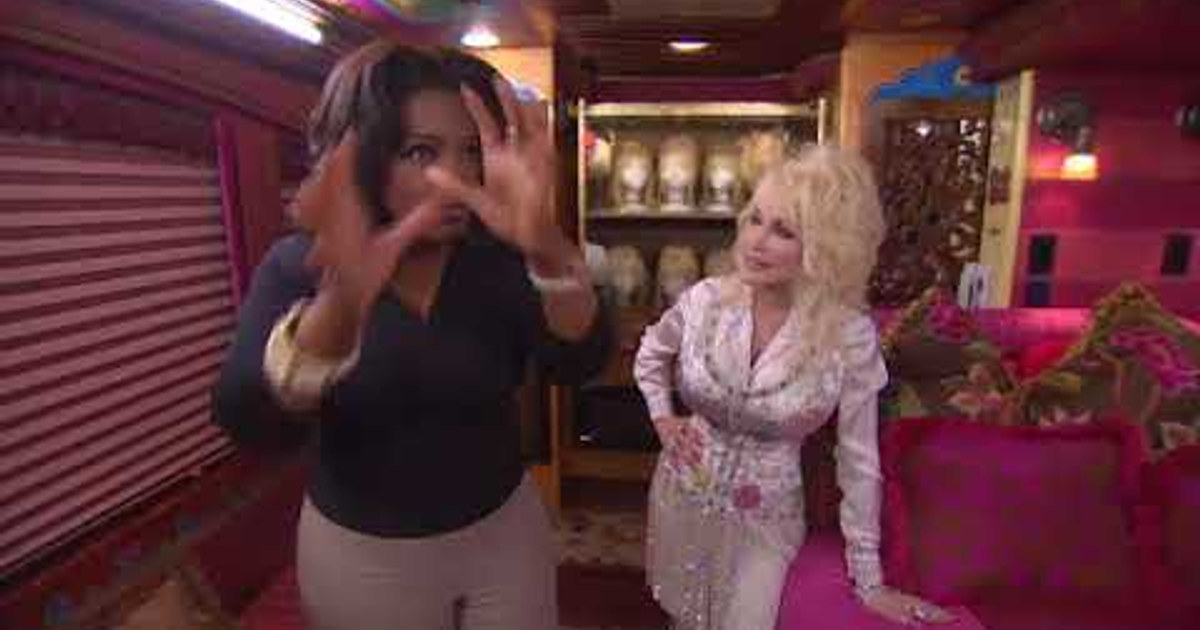
The clip opens on a camera parked outside Harpo Studios in Chicago. A coach has been sitting there since 4 a.m. The interviewer says, “I’m going to go inside and check it out.” That’s the whole entry ritual: a door, a step, a greeting. And in that moment, two completely different viewers click the same thumbnail.
Viewer A came for the genre. They want the wigs, the prayer altar, the tomatoes flown in from LA through a Nashville winter, the quiche with a pork-rind crust. They’re here for the spectacle of a superstar’s mobile home—the same itch that made MTV Cribs a phenomenon starting in 2000, that Architectural Digest scratched with its Open Door series from 2017 onward, and that Vogue’s 73 Questions has been scratching since 2012. Viewer A doesn’t care how the sausage is made; they care that the sausage is wearing a wig and sitting in a tiny cosmetic chair.
Viewer B came for the craft. They want to know how you block, light, and mic a 40-foot aluminum tube with two people in it. They’re watching the camera operator’s footwork, the way the interviewer becomes a human dolly, the way the space itself dictates the edit. They’re the kind of person who pauses to count the cuts—and then gets excited when there aren’t many.
Neither viewer is wrong. In fact, the best way to understand this segment is to treat it as a conversation between those two instincts. The genre viewer is the reason the clip exists. The craft viewer is the reason it survives a second watch. And Dolly Parton—who has been a star for over half a century—knows exactly how to feed both.
Let’s start with the host dynamic, because it’s an engineering fact before it’s a personality note. The interviewer is the audience’s proxy and the camera’s dolly. Every “ooh” and “ah” is a cue for the operator to pan, tilt, or push in. Dolly, meanwhile, is the docent, the set designer, and effectively the director of her own space. She doesn’t just show you the bus; she blocks the scene. “Let’s go to the back,” she says, and the camera follows. “Come here, I’ll show you all of my goodies,” and we’re in the wig closet. She’s not just the talent—she’s the location scout, the art director, and the star.
Harpo Studios is Oprah Winfrey’s Chicago production home, which is why this segment reads as a doorstep-to-interior journey rather than a red-carpet stop. It’s not a press junket; it’s a house call. The bus is parked outside the studio where The Oprah Winfrey Show was syndicated from 1986 to 2011 and where the OWN era continued after 2011. That context matters: this isn’t a rented soundstage. It’s a real place with a real history, and the bus is a real home.
Now, the genre contract, in plain programmer terms: the star is the module, the home is the API, and access is the payload. The wigs, the tiny cosmetic chair, and the “I can sit in that tub” gag are documented features, not bugs. When Dolly says, “I’m so little I can just sit right in there,” and the interviewer protests, “You cannot sit in that tub,” that’s a scripted beat in an unscripted scene. It’s the kind of moment that made MTV Cribs iconic—the rapper showing off the shark tank, the athlete with the custom shoe closet. The genre viewer eats it up because it’s a reveal, a reaction, and a punchline all at once.
But the craft contract is just as plain: every reveal is a cue. The doorway is act one. The bunk corridor is act two. The bedroom-cum-office-cum-chapel is act three. A 40-foot space has been reorganized into a three-act structure with almost no cutting. The camera doesn’t jump; it follows. The interviewer’s questions are the transitions. “Are these fresh tomatoes?” moves us from the galley to the dining area. “So, are all your girls on here? Your wigs?” moves us from the bathroom to the closet. “Do you eat on here?” moves us from the cosmetic area to the kitchen. It’s a masterclass in spatial storytelling, and it happens in real time.
To anchor both viewers, it helps to sketch Dolly Parton’s dual résumé. She’s the star of 9 to 5 (1980), The Best Little Whorehouse in Texas (1982), Steel Magnolias (1989), Straight Talk (1992), Joyful Noise (2012), Dumplin’ (Netflix, 2018), and Dolly Parton’s Christmas on the Square (Netflix, 2020). She’s also the songwriter behind “I Will Always Love You,” “Jolene,” and “9 to 5.” She’s a businesswoman, a philanthropist, and a cultural institution. But in this clip, she’s something else: a woman who lives on her bus. “I don’t ever check in hotels anymore,” she says. That line is a logistics statement first and a flex second. It’s the hinge the final section will swing on.
Warn gently: nothing here is scripted, but everything is staged. The tomatoes didn’t just happen to be there; they were flown in from LA through a Nashville winter. The prayer altar didn’t just appear; it’s a permanent fixture. The tiny chair isn’t a prop; it’s custom-built for a tiny person. Both viewers should watch the same thirty seconds differently. Viewer A sees the quiche with the pork-rind crust and thinks, “That’s fabulous.” Viewer B sees the quiche and thinks, “That’s a low-carb workaround that tells us she’s disciplined, and the pork rinds are a regional ingredient—this is character exposition.” Same quiche, two payloads.


