Part 5
What Reese Saw in Dolly
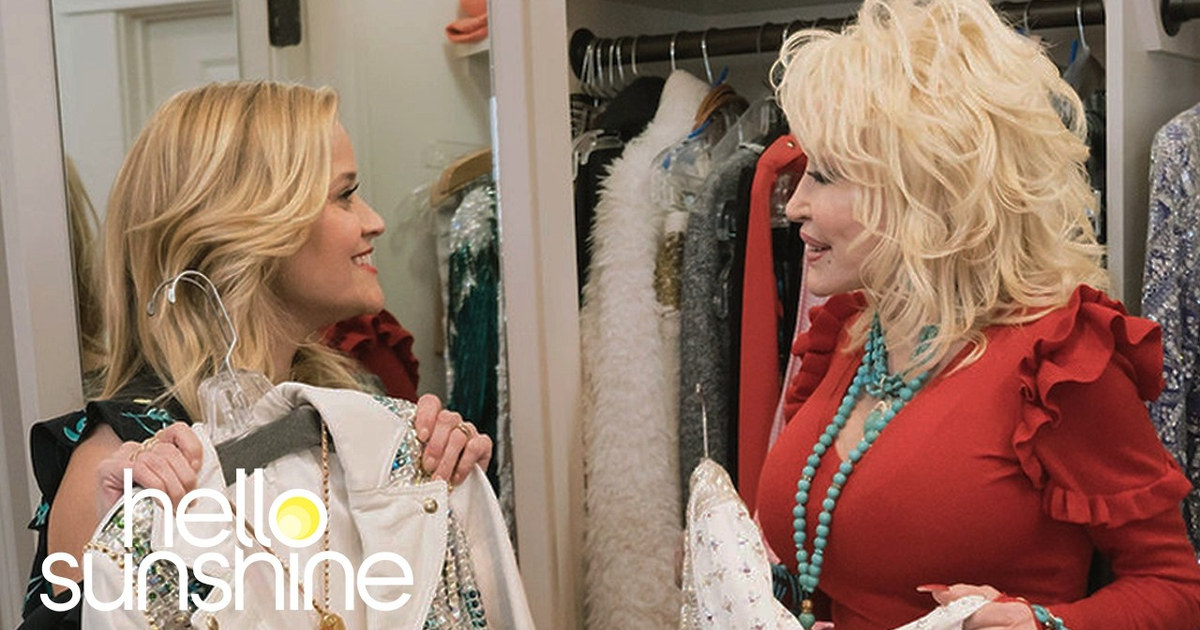
Now cut to the interview. Reese is doing a show about powerful, ambitious women in different fields — her own words — and Dolly is one of the first people she thinks of. Not because of the rhinestones. Because of the reps. "No one in country music has gone through more different iterations of being a business woman."
There's your trailer line. Iterations. Businesswoman. Say it out loud and the whole catalog reorganizes itself.
Singer on a porch. Radio star. TV co-host. Songwriter for hire. Movie star. Publisher. Theme-park owner. Producer. That's not a career, it's a franchise — and it got built one refusal at a time.
[[AD]]
Count the beats. 1967, she joins The Porter Wagoner Show. 1974, she writes "I Will Always Love You" to say goodbye. 1980, she's Violet in 9 to 5 — 109 minutes, Colin Higgins directing, Lily Tomlin and Jane Fonda at the next desks, a title song with its own awards-season run. 1982, The Best Little Whorehouse in Texas. 1989, Steel Magnolias — Herbert Ross, 117 minutes, a supporting turn that still holds up. And through all of it, she's the one signing her own checks.
Six decades. 47 Grammy nominations. Country Music Hall of Fame. The kind of numbers you print on a poster and hope nobody audits. They audit. They hold.
No One Gets a Ceiling
Here's the idea Reese names out loud. People treat success like a pie with one slice left. "There's only a certain amount of success and if she gets it, I won't."
Dolly's answer is immediate. That was never true in her own life. Her sisters, her aunts, her grandmas, her mom — "we just had this whole world of women that kind of stuck together. The women in the church... we were stronger together."
That's not sentiment. That's infrastructure.
Watch how she uses it. Every time she has to leave something — a man, a contract, a show, a town — she isn't carrying the exit alone. She's carrying a whole church pew of women, and a mother who fought her father so she could get to Nashville with her Uncle Bill.
Sleep in the car. Her bedroom was the back seat, his was the front. Hair washed in gas-station bathrooms. Makeup in the side mirror. That's a kid with a 5 a.m. call time and no trailer. That's the origin of every business decision she'd ever make: don't wait for someone to hand you a room. Build one in a car.
The Businesswoman Was There at 18
She graduated high school on a Friday night and came to Nashville. Eighteen years old. Barely got through school. Never went to college. "But I had my dreams early on. I knew what I wanted to do."
That's the thing about the rope. It's not that the kid guessed right. It's that she'd already named it. Ambition doesn't arrive later as a bonus. It shows up early, and it either gets fed or it gets flattened.
Context matters here. Twelve kids in the house: Willadeene, David, Denver, Dolly, Bobby, Stella, Cassie, Randy, Larry, Floyd, Freida, Rachel. No running water unless they ran and got it. They worked their own fields, grew their own food, canned it, raised their own hogs. Daddy was strict. He didn't want her getting out in the world. Didn't even want her going to school. Mom knew she had a strength. Mom fought for her. That's the first deal Dolly ever won — and she didn't negotiate it. Somebody else did, on her behalf.
Then the hair. First box of bleach. She reads the label: "Do not get in eyes. To do so may cause blindness." Her sister's rinsing her head at the well, water running into her eyes, and she's panicking. "I didn't want to be blind. I wanted to be blonde."
That's the entire operating system in one sentence. The look is a choice. So is what comes next.
"Ain't No Man Going to Stop You"
And then the record companies. Eighteen. Yes, they tried to change the look. She kept the look. Kept the hair. Kept the voice. Kept the name.
She's blunt about why: "You got to get out and work. A lot of women hide behind excuses. You can make it if you're willing to sacrifice. Ain't no man going to stop you if you've got the talent. You might have to work harder, but it can be done. I'm a prime example."
Play that loud. More reps. Fewer excuses. She says the quiet part on camera: the door isn't locked, it's heavier — and she has zero patience for anyone who won't push.
Which loops straight back to Reese. She watched Dolly's iterations and built her own. Legally Blonde in 2001 — Robert Luketic, 96 minutes — a character underestimated in every room who wins anyway. Then the second act nobody predicted: producing.
Wild, 2014, Jean-Marc Vallée, 115 minutes. Gone Girl, same year, David Fincher, 149 minutes. Big Little Lies on HBO in 2017. The Morning Show on Apple TV+ in 2019. A company called Hello Sunshine, built on one rule — women drive the story.
And when she needed a name to explain why, she didn't reach for a producer. She reached for the woman she named at recess. "That's how I, as a grown-up woman, feel about Dolly Parton." Like a kid seeing Minnie Mouse at Disneyland. Grown woman, hero, zero irony.


