Part 4
The whole list is framed as "live from Dollywood," a phrase that turns the theme park into a television studio, a home base, a stage. And throughout, there are these mock-reluctance beats—"let's just go home, Dolly," "have we done all 10 yet?"—that make the countdown feel like a conversation, not a performance. Letterman plays the straight man, but he's also the foil. He's the one with the hairpiece crisis. He's the one who's not Dolly Parton. And the audience laughs because they know it's true.
What makes this list more than a list is the way each item is a small scene, a chapter, a joke with its own logic. The accountants, the nails, the hair, the Dalai Lama, the wig, the rash, Garth Brooks, the MC, the Super Bowl, the ass—they are not random. They are a portrait. They are the things that annoy a woman who has been famous for so long that her image has become a public utility. And they are funny because they are specific. Because they are true. Because they are Dolly.
Why Dollywood, Garth Brooks, and the Dalai Lama All Belong in the Same Joke
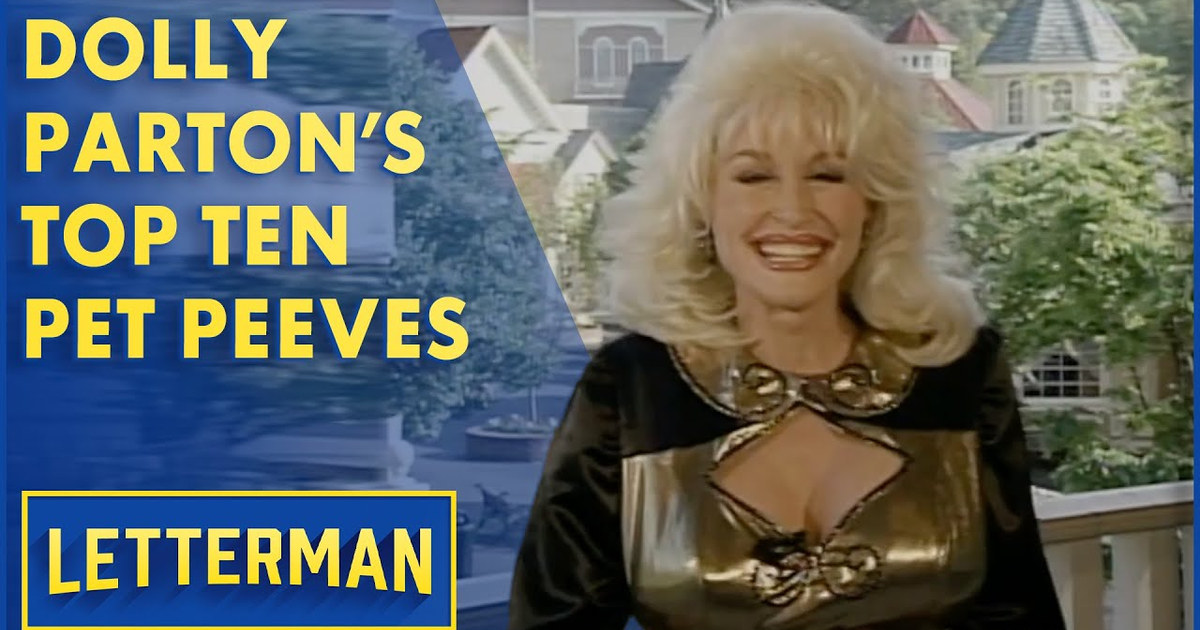
Picture the moment: Dolly Parton, live from Dollywood, reads the number one item on her pet peeve list. "Nobody notices I've got a great ass too." The studio audience roars. Paul Shaffer's CBS orchestra vamps something sly. And in that instant, the biggest star in the room is the one making herself the butt of the joke. It's not a put-down. It's a takeover.
That's the trick of Dolly's entire public self. She's built a persona large enough to contain accountants, the Dalai Lama, Garth Brooks, the Super Bowl, and her own backside—all in one breath. The pet-peeve list isn't just a gag reel. It's a compressed version of how she's managed her image for five decades.
Self-deprecation, in Dolly's hands, is ownership. When she jokes about how much it costs to make her look "this cheap," she's not belittling herself. She's reminding you that she's the one who designed the look. When she complains that her five-inch fingernails make guitar playing impossible, she's acknowledging the artifice while daring you to question it. The joke is always on her terms.
You can trace this back to her earliest screen appearances. In 9 to 5 (1980), directed by Colin Higgins, she played Doralee Rhodes—a secretary whose boss spreads rumors that she's sleeping with him. Dolly didn't play the victim. She played the fantasy and then flipped it, tying the boss up and taking control. The film grossed over $103 million on a $10 million budget and turned her into a movie star. But more importantly, it showed she could weaponize her own caricature.
[[AD]]
Two years later, in The Best Little Whorehouse in Texas (1982), she played Miss Mona Stangley, the madam of a legendary brothel. The role could have been exploitative. Instead, Dolly made Mona warm, maternal, and fiercely independent. The film, directed by Colin Higgins again, was a musical comedy that let her sing and spar with Burt Reynolds. It wasn't a critical darling, but it reinforced her ability to own a character who might otherwise be a punchline.
Then came Steel Magnolias (1989), directed by Herbert Ross. Dolly played Truvy Jones, the wisecracking salon owner who dispenses wisdom and hairspray in equal measure. The film, based on Robert Harling's play, was a massive hit, grossing over $95 million. Dolly held her own alongside Sally Field, Julia Roberts, Shirley MacLaine, and Olympia Dukakis. She wasn't the star, but she was the heart. And she did it without ever breaking character as Dolly Parton—the accent, the wig, the warmth were all part of the package.
But before all that, there was the variety and talk-show circuit of the 1970s and '80s. Dolly was a regular on The Tonight Show Starring Johnny Carson, where she'd banter about her looks and her upbringing. She hosted her own variety show, Dolly, in 1976–77, which ran for one season on ABC. She appeared on The Carol Burnett Show, The Muppet Show, and countless others. Every appearance was a masterclass in persona management: she'd tell a self-deprecating joke, then sing a devastatingly beautiful song, and you'd realize the joke was just the doorway to the real thing.
The pet-peeve list on Late Show with David Letterman is a distilled version of that same strategy. In three minutes, she references her hair, her nails, her rhinestones, her theme park, her famous friends, and her rear end—all without ever losing control of the narrative. She's the one holding the pen.
Take the Dollywood joke. "Confused Dalai Lama constantly asking for theme park royalties." On the surface, it's absurd. The Dalai Lama, the spiritual leader of Tibetan Buddhism, demanding a cut of a Tennessee amusement park? But it works because Dollywood is real. She opened it in 1986 in Pigeon Forge, Tennessee, and it's grown into a massive enterprise with millions of visitors annually. The joke turns a commercial empire into a punchline she controls. She's not bragging about her success; she's inviting you to laugh at the sheer improbability of it all. And by including the Dalai Lama, she's signaling that her world is so big it can contain anyone—even a Nobel Peace Prize winner.
Then there's Garth Brooks. "When he visits Dollywood gift shops, Garth Brooks always shops at the shoplifts stuff under that big hat of his." It's a gentle ribbing of a fellow country superstar. Garth, with his arena tours and record-breaking sales, is a peer. But Dolly positions herself as the elder stateswoman, the one who can tease him because she's been there. The joke also reminds you that Dollywood is a real place where real celebrities might actually show up. It's world-building through comedy.


