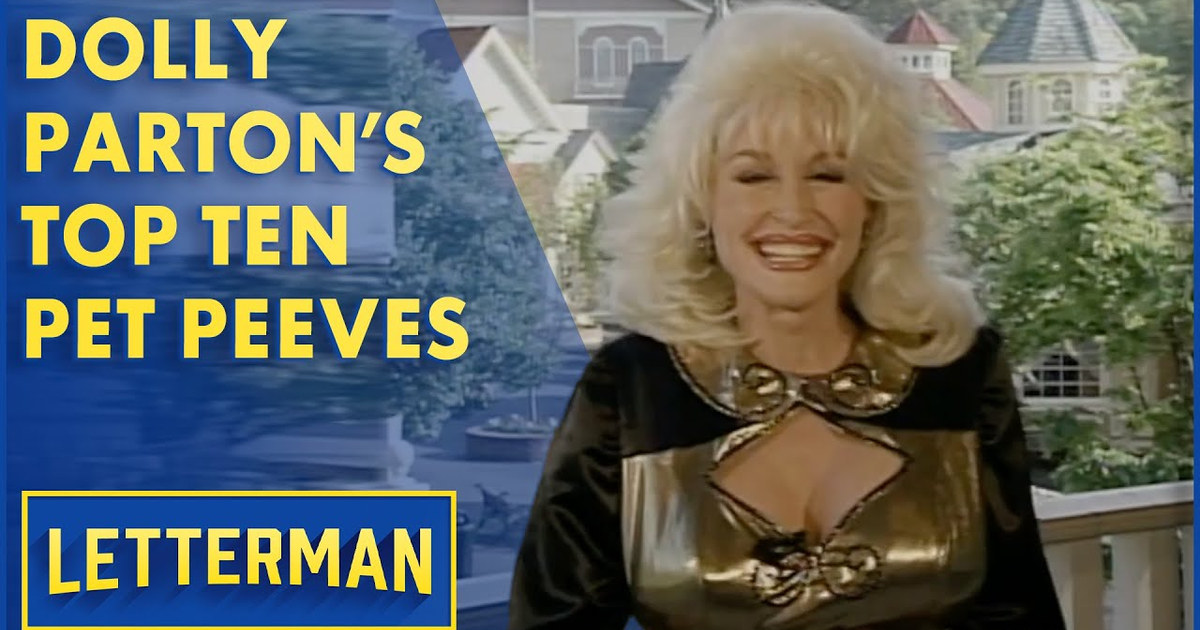
Part 3
Number nine: "Trying to play guitar in these five-inch fingernails." This is not a throwaway. Dolly's instrument is her guitar. Her nails are not a prop; they are a physical constraint she performs around. She has said she writes songs with those nails, plays with them, and the comedy comes from the collision of glamour and function. On The Late Show, Letterman's band—Paul Shaffer and the CBS Orchestra—became part of the bit. "When are we gonna have them on the show, Paul? Five-inch fingernails—that's my favorite new band." The nails become a character, a recurring guest, a running gag that outlasts the list itself. It's a joke about dexterity, but it's also a joke about how the world sees her: as spectacle first, musician second. The nails are the sentence; the guitar is the meaning.
Number eight: "When the county declares my hair a fire hazard." This is a small scene, fully rendered in one line. You can see the inspector, the clipboard, the towering blonde monument. It's absurd, but it's also a comment on how her image has become a public utility—something that must be regulated, contained, insured. The hair is not just hair; it's infrastructure. And the county, faceless and bureaucratic, is the straight man to her punchline.
Number seven: "Confused Dalai Lama constantly asking for theme park royalties." This is the wildest one, and it's perfect. The Dalai Lama, the spiritual leader of Tibetan Buddhism, reduced to a confused businessman demanding a cut of Dollywood. It's a joke about appropriation, about the collision of the sacred and the commercial, and about the sheer weirdness of being Dolly Parton—a woman whose name is a brand, a park, a franchise. The Dalai Lama doesn't get royalties. But in Dolly's world, everyone wants a piece. The line lands because it's so specific and so absurd that it becomes true.
Number six: "You can't get a wig repaired because Letterman's got some kind of a hairpiece crisis." And here the mirror turns. The joke is not just on Dolly; it's on Dave. The host's own vanity becomes the punchline. Cut to the recurring bit: "Dave's cousin Kenny." Letterman would appear in a bad wig and glasses, pretending to be his own cousin, filling in while Dave "went home early." It's a self-deprecating gag that acknowledges the artificiality of television, the performance of identity, and the fact that everyone on that stage is wearing a costume. Dolly's wig crisis is Dave's hairpiece crisis. They are the same joke, told from opposite sides of the desk.
Number five: "Rhinestone rash." Two words, one image. The glitter that makes her sparkle also makes her itch. It's a joke about the cost of glamour, physical and literal. The rhinestones are not just decoration; they are a skin condition. The punchline is tactile. You can feel it.
[[VIDEO]]
Number four: "When he visits Dollywood gift shops, Garth Brooks always shops at the shop that lifts stuff—under that big hat of his." This is a masterclass in layering. First, you have Garth Brooks, the biggest country star of the '90s, a man with his own larger-than-life persona. Then you have Dollywood, the theme park that is an extension of Dolly's identity. Then you have the shoplifting joke, which is both a crime and a punchline. And then you have the hat—the big hat—which is not just a hat but a hiding place, a prop, a symbol of country stardom. The joke works because it's specific. It's not "a country star"; it's Garth Brooks. It's not "a gift shop"; it's the shop that lifts stuff. The details are the story.
Number three: "Smart-ass MCs who introduce me by saying, 'And now, here they are, Dolly Parton.'" This is a joke about grammar and ego. "Here they are"—plural—as if she is a band, a spectacle, a collection of parts. The MC reduces her to a pronoun, a plural, a thing. And she notices. She always notices. The line is a complaint, but it's also a flex: she knows exactly how she should be introduced. She knows her own name. The joke is about respect, and about the gap between how she sees herself and how the world announces her.
Number two: "When the Super Bowl is over, the winner never says, 'Hey, I'm going to Dollywood.'" This is a joke about cultural hierarchy. The Super Bowl winner goes to Disney World—"I'm going to Disney World!"—a phrase that has been part of American sports mythology since 1987. Dolly's complaint is that no one says Dollywood. It's a joke about brand envy, about the pecking order of American entertainment, and about the fact that Dollywood is a real place, a real park, a real empire. The punchline is that she's not asking for much. Just a shout-out. Just a little recognition. And the fact that she's not getting it is the joke.
And then number one: "Nobody notices I've got a great ass too." This is the thesis. After nine jokes about wigs, nails, hair, rhinestones, theme parks, and Super Bowl winners, the final pet peeve is about being seen—and mis-seen. Dolly Parton has been famous for her bust since the 1960s. Her body has been a punchline, a brand, a monument. And here she is, at number one, saying: you've noticed the top, but you've missed the bottom. It's a joke about objectification, but it's also a joke about agency. She is the one making the joke. She is the one directing your gaze. The line lands because it's true, because it's self-aware, and because it's the one thing she's never been allowed to say. She's got a great ass too. And she wants you to know it.


