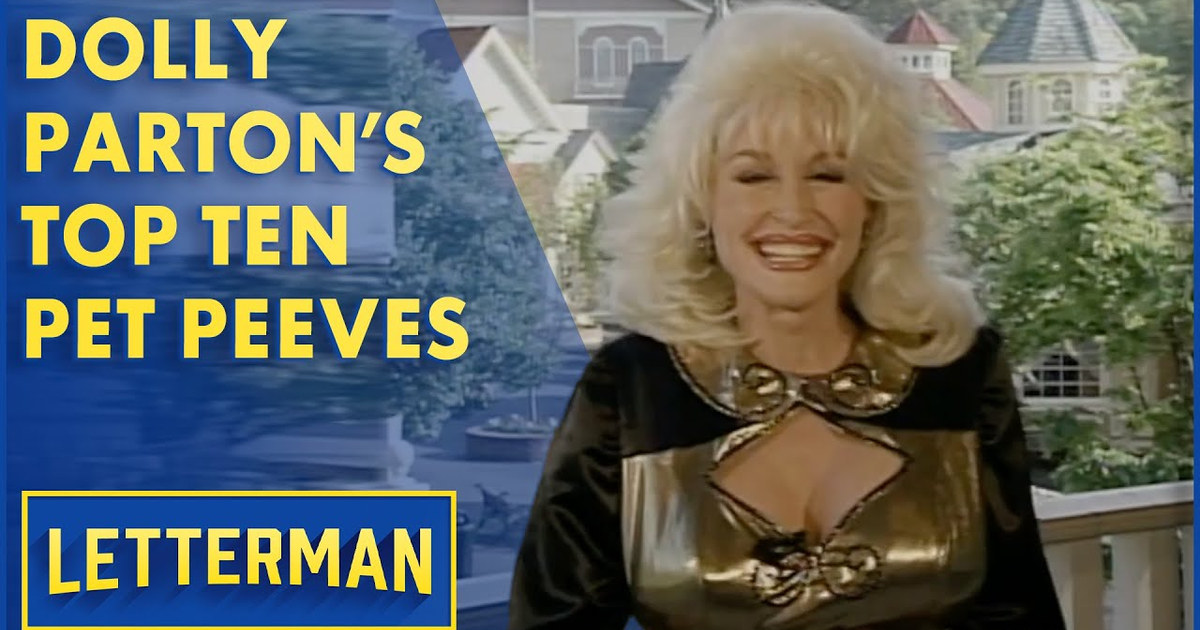
Part 2
And then the Dalai Lama. Confused Dalai Lama constantly asking for theme park royalties. This is the joke that tells you everything about the scale of Dolly Parton's self-mythology. She is not just a singer. She is not just a songwriter. She is a theme park owner. Dollywood is real. Dollywood is in Pigeon Forge, Tennessee. Dollywood has been operating since 1986. And in the universe of this Top 10 list, the Dalai Lama — the spiritual leader of Tibetan Buddhism, a Nobel Peace Prize winner, a man who has met presidents and popes — is confused about whether he is owed money by a country music star's amusement park. The joke is absurd. The joke is also a flex. Because who else could make that joke? Who else has a theme park big enough to be a punchline?
The wig joke is a Letterman joke. You can't get a wig repaired because Letterman's got some kind of a hairpiece crisis. This is the moment where Dolly Parton turns the camera around. She is not just the subject of the joke. She is the comedian. She is punching at the host. And Letterman — who has spent his entire career being the smartest guy in the room — gets to be the guy with the hairpiece crisis. It is a gift. It is also a power move. Because in that moment, Dolly Parton is in charge. She is not the guest. She is the star.
Then Garth Brooks. When he visits Dollywood gift shops, Garth Brooks always shops at the shop, lifts stuff under that big hat of his. This is a country music joke. This is a Nashville joke. This is a joke about the biggest male star in country music at the time — Garth Brooks, who in the 1990s was selling more records than anyone, who was filling stadiums, who was the face of the genre — being a shoplifter at Dollywood. The joke is not mean. The joke is affectionate. But the joke is also a reminder: Dolly Parton was there first. Dolly Parton built the theme park. Dolly Parton is the institution. Garth Brooks is the guy who lifts stuff under his hat.
The smart-ass MC joke is the most self-aware joke on the list. Smart-ass MCs who introduce me by saying, 'and now here they are, Dolly Parton.' The grammar is wrong. The pronoun is wrong. 'They' instead of 'she.' And Dolly Parton — who has been introduced thousands of times, in thousands of venues, by thousands of announcers — has noticed. She has noticed that people don't know how to introduce her. She has noticed that the language does not fit. And she has turned that into a joke. That is not just comedy. That is criticism. That is a woman who has been paying attention to every slight, every mistake, every moment of disrespect, and has decided to laugh about it instead of cry.
The Super Bowl joke is the biggest joke on the list. When the Super Bowl is over, winner never says, 'Hey, I'm going to Dollywood.' This is a joke about scale. The Super Bowl is the biggest television event in America. The winner is the most celebrated athlete in the country. And in the universe of this joke, the winner should be going to Dollywood. Not Disney World. Not Vegas. Dollywood. It is a joke about ambition. It is a joke about branding. It is a joke about the fact that Dolly Parton — a woman who grew up in a one-room cabin in the Smoky Mountains with eleven siblings — built a theme park that she thinks should be the victory lap for the Super Bowl champion. And the joke is that she is not entirely wrong.
And then number one. Nobody notices I've got a great ass too. This is the joke that lands the whole list. Because it is the joke that is about the one thing Dolly Parton has never been allowed to be: a body. She has been a voice. She has been a songwriter. She has been a businesswoman. She has been a philanthropist. She has been a joke. She has been a legend. But she has not been a woman with a great ass. And the joke is that she has one. And nobody notices. And she is a little bit annoyed about it. And she is going to say so on national television. In the 1990s. On CBS. Live from Dollywood. Her own self.
That is the moment. That is the whole essay. A woman who has spent decades constructing the most deliberate public persona in American entertainment sits behind a desk on CBS and reads a list of things that annoy her, and every single line is a joke she is in on. And the last line is the one that tells you everything: she is not just in on the joke. She wrote it.
This is not a clip to summarize. This is a small comic scene that reveals how Dolly Parton writes herself in public. And it is only the beginning. Because the countdown is not just a list. It is a novel. And every joke is a chapter.
[[AD]]
Reading the Countdown Like a Novelist: Every Joke Is a Chapter
The list begins at number ten, and already we are in the land of accounting. "Accountants who don't understand how much it costs to make me look this cheap." It's a joke about glamour's hidden invoice, but it's also a thesis statement. Dolly Parton has built a half-century career on the tension between appearance and authenticity, and here she is, in one line, telling us that the cheap look is the expensive one. The punchline is economics. The subtext is craft. It's the kind of line a novelist would underline—because it tells you how to read everything that follows.


