Part 1
The Night Dolly Parton Counted Down Her Own Pet Peeves
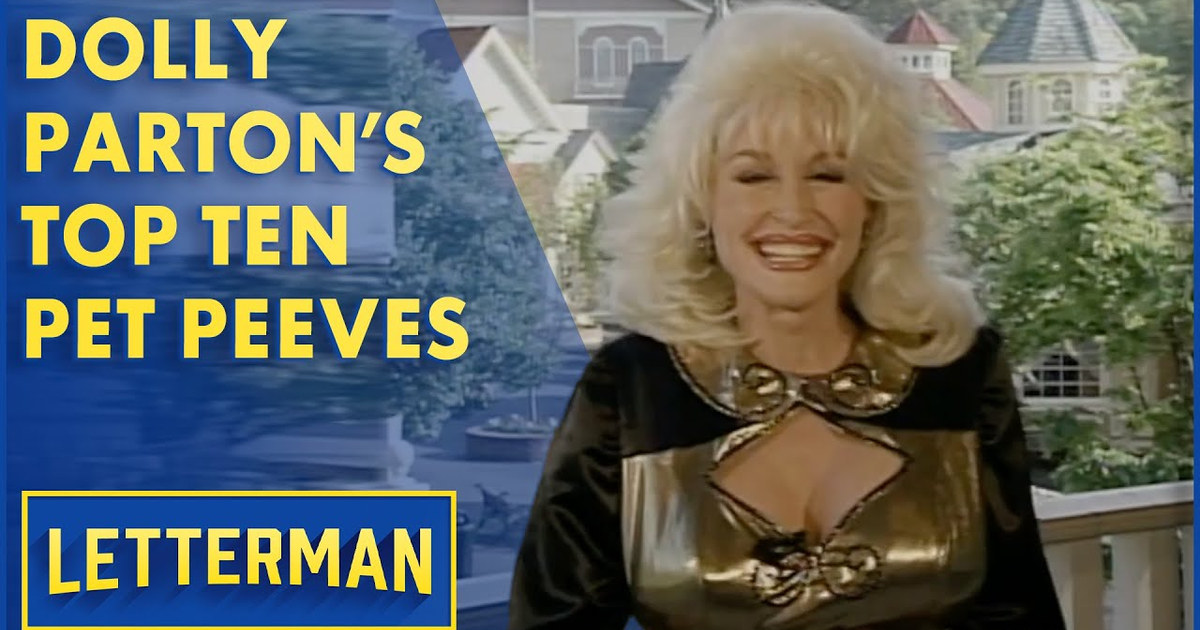
The home office is in Sioux City, Iowa. It is always in Sioux City, Iowa, a fact that has never stopped being funny to anyone who has ever been to Sioux City, Iowa. The announcer leans into the microphone and tells America to get up real close to the set, because tonight's list is a good one. And then the category lands: Top 10 Dolly Parton Pet Peeves. The camera cuts. Live from Dollywood, in the flesh, in the hair, in the nails, in the rhinestones, sits Dolly Parton — her own self — ready to read the list. She is not there to promote an album. She is not there to sing. She is there to complain about her own life, in character, on cue, and she is going to enjoy every second of it.
That is the moment. That is the whole essay, really. A woman who has spent decades constructing the most deliberate public persona in American entertainment sits behind a desk on CBS and reads a list of things that annoy her, and every single line is a joke she is in on. The bit is small. The bit is also a masterclass.
To understand why it works, you have to remember what the Top 10 list was on Late Show with David Letterman. It was not a sketch. It was not a monologue. It was a nightly ritual — a countdown from ten to one, delivered by Letterman at the desk, often with a guest reading the punchlines. The format was rigid. The format was sacred. And the format was, above all else, a delivery system for one thing: the joke at the end of the line. Paul Shaffer's band would vamp. The audience would lean in. And the guest would either rise to the occasion or sink. There was no middle ground.
Which is why Dolly Parton was the perfect person to read her own pet peeves. Because Dolly Parton does not need a setup. She is the setup. The hair is the setup. The nails are the setup. The rhinestones are the setup. When she walked out — or in this case, when the camera cut to her live from Dollywood — the audience already knew the rules of the world they were in. They knew the accent. They knew the laugh. They knew that whatever came out of her mouth next would be delivered with the timing of a woman who has been performing since she was a child on local Tennessee television. The Top 10 list gave her a structure. She gave it a soul.
And what a structure it was. Number ten: accountants who don't understand how much it costs to make me look this cheap. Number nine: trying to play guitar in these five-inch fingernails. Number eight: when the county declares my hair a fire hazard. Number seven: confused Dalai Lama constantly asking for theme park royalties. Number six: you can't get a wig repaired because Letterman's got some kind of a hairpiece crisis. Number five: rhinestone rest. Number four: when he visits Dollywood gift shops, Garth Brooks always shops at the shop, lifts stuff under that big hat of his. Number three: smart-ass MCs who introduce me by saying, 'and now here they are, Dolly Parton.' Number two: when the Super Bowl is over, winner never says, 'Hey, I'm going to Dollywood.' And number one: nobody notices I've got a great ass too.
Read that list again. Slowly. Because it is not just a list. It is a self-portrait in ten lines. It is Dolly Parton writing Dolly Parton, in public, for laughs, and somehow making it look effortless. Every joke is a chapter. Every punchline is a piece of characterization. And the woman delivering them is not the butt of the joke. She is the author.
This is not a clip to summarize. This is a small comic scene that reveals how Dolly Parton writes herself in public — and how she has been doing it, with surgical precision, for over half a century.
Think about the first joke. Accountants who don't understand how much it costs to make me look this cheap. The word 'cheap' is doing all the work. Dolly Parton has never looked cheap. Dolly Parton has looked like a million bucks since the 1960s. But the joke is not about the money. The joke is about the gap between the effort and the effect. The effort is enormous. The effect is supposed to look effortless. And the accountants — the people who count the money — are the ones who don't get it. That is a joke about art. That is a joke about the business of being a woman in show business. And it is delivered with a smile so wide you almost miss the knife.
Then the nails. Five-inch fingernails. They're great. When are we gonna have them on the show, Paula? Five-inch fingernails, I'm telling you, that's my favorite new band. The joke turns into a bit. The bit turns into a riff. And suddenly Dolly Parton is not just reading a list. She is hosting. She is playing with the format. She is doing what she has always done: taking the thing she is given and making it bigger, warmer, and funnier than anyone expected.
The hair joke is next. When the county declares my hair a fire hazard. This is the joke that only works because everyone in America has seen the hair. The hair is not a hairstyle. The hair is a landmark. The hair is a character in the Dolly Parton story. And the joke is not that the hair is big. The joke is that the government has an opinion about it. The county. The local government. The bureaucracy. Dolly Parton's hair is so powerful that it requires regulation. That is not a punchline. That is a world-building detail.


