Part 3
Test it with the names she actually gives you, because they're all geography. The Cas Walker Show in Knoxville — a local barn-burner of a program where a kid could get on television decades before country music had a national pipeline. The husband-and-wife duet act Carl and Pearl Butler, close-harmony people who made heartbreak sound like furniture. And then Roy Acuff.
She calls him the father of Nashville. That's not a throwaway compliment. Acuff was born in 1903 in Maynardville, Tennessee, and by the time he was done he'd become the cornerstone of the Grand Ole Opry and the gravitational center of the entire Nashville music scene — a man so generous to everyone in the business that the generosity became part of his legend. He died in 1992, only a few years before this conversation happened. Dolly isn't name-dropping a hero. She's describing a neighborhood.
Which is the thing worth sitting with. Before Nashville was an industry, it was a place, and the place had a radio station. The Grand Ole Opry was the streaming service of its day — a literal platform, in the most physical sense, that carried a genre out of the hills and into American living rooms on Saturday nights. When Dolly lists Acuff, Hank Williams, Kitty Wells, Ernest Tubb and Porter Wagoner, she isn't rattling off a hall of fame. She's naming the frequency.
Hank Williams gets special treatment, and it tells you how she hears music. She doesn't talk about the man. She talks about the writer. Nobody's ever touched him as far as she's concerned — that's the ranking, plain and simple, and she means it as a songwriter's verdict rather than a critic's. Then Porter Wagoner, whose television show she watched from back home before she ever moved to town, and then later worked on as a duet partner. Porter is the bridge in her own biography: the thing she loved from a distance, then stood inside of. That's not a career ladder. That's a kid watching a signal and then becoming the signal.
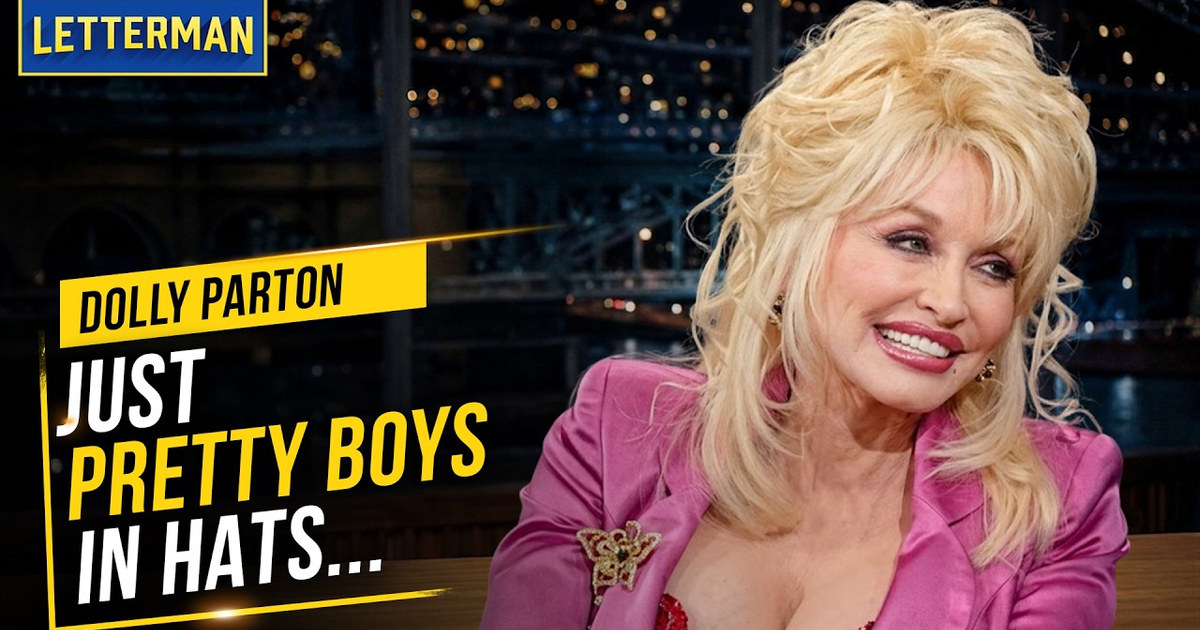
Then the host takes his swing. Pretty boys and hats, he says — the familiar jab, the one that's been aimed at every generation of country stars since the first cowboy hat was sold in a Nashvile storefront. And here is where the interview earns its keep, because Dolly doesn't fold and she doesn't sneer. She answers with pride first. Country music grew. It got bigger, wider, more ambitious, and it did that on purpose, and there is nothing small about that. And then — because she's Dolly — she concedes the point with a laugh, letting the joke land without pretending it bounced.
Take that exchange seriously instead of turning it into a takedown of anybody. The current era has Luke Combs, Chris Stapleton, Morgan Wallen, Zach Bryan, the whole denim-and-felt wave, and they're not the story. The story is distribution. Country music's center of gravity has moved off the Opry stage and onto Spotify, Apple Music and TikTok, where a hat and a chorus can travel further in a week than a single could travel in a year on country radio. That's not a moral collapse. That's a change in the pipes. Dolly's career started on a local Knoxville TV show because that was where the pipe ran in 1960. The pipe is different now. The water is the same.
And since we're a film site, this is where the canon opens up, because country music has been getting itself photographed for nearly a century. Start with the documentary shelf: Ken Burns's Country Music, which aired on PBS in 2019, is the definitive long-form history — sixteen and a half hours of it, all the way from the Carter Family's porch to the neon of the modern era. If the songbook in this interview is the subject, Burns is the textbook.
Then the narrative canon. Coal Miner's Daughter, Michael Apted's 1980 film, runs a little over two hours and gives you Sissy Spacek as Loretta Lynn in the performance that won her the Academy Award — the image to hold in your head is a child on a Kentucky porch with a coal camp behind her, singing into the same kind of air Dolly grew up in. Beverly D'Angelo plays Patsy Cline in it, and together the two of them make the movie's real argument: that a female voice could carry an entire industry on its back. Robert Altman's Nashville, from 1975 and nearly three hours long, used the industry the way a novelist uses a small town — as a mirror held up to the whole country in its bicentennial hangover. Altman doesn't love his characters so much as he listens to them, and the listening is the film.
[[AD]]
The Coen brothers' O Brother, Where Art Thou? arrived in 2000 with a T Bone Burnett soundtrack that sent mountain music back up the charts two decades after most labels had written it off — think of the trio on the riverbank with the Soggy Bottom Boys, a scene shot in brown and gold, and you've got the whole thesis: this music never died, it just went quiet for a while. Crazy Heart came in 2009 and won Jeff Bridges an Oscar for playing a broken-down country singer in a bowling alley, an image that's basically the genre's shadow self. And A Star Is Born, the 2018 version, gave us Bradley Cooper and Lady Gaga in the fourth remake of a story that's been carrying country-adjacent melodrama since 1937 — a stadium, a spotlight, and a woman walking out of the silence to fill it. On television, Nashville ran from 2012 to 2018, first on ABC and then on CMT, and stands as the era's most direct heir: a prime-time soap that treated the song as the argument.


