Part 4
That's the magic trick. The impersonator becomes the real thing for a second. Not because she sounds perfect. Because she's singing with a Kenny. Because the source is listening. Because the audience is holding its breath.
The duet is rough. It's phone-quality. It's not a record. That's why it works. It's intimate. It's messy. It's live. It's the opposite of a polished music video.
Dolly's laugh is the final beat. It's the same laugh Mary studied. The same laugh in '9 to 5' (1980, Colin Higgins, 109 minutes). The same laugh in 'Steel Magnolias' (1989, Herbert Ross, 117 minutes). The same laugh in 'Dumplin'' (2018, Anne Fletcher, 110 minutes, Netflix). Mary can copy the sound. She cannot copy the source.
That's why we rewind. We rewind to hear the real thing cut through. We rewind to watch Mary's disbelief turn into joy. We rewind because the clip gives us a rare thing: a celebrity who is also a fan of her own fans.
Dolly never breaks character as the prankster. But she's not a prankster. She's the subject. She's the source. She's the woman whose voice has been borrowed for decades. She could be threatened. She isn't. She's delighted.
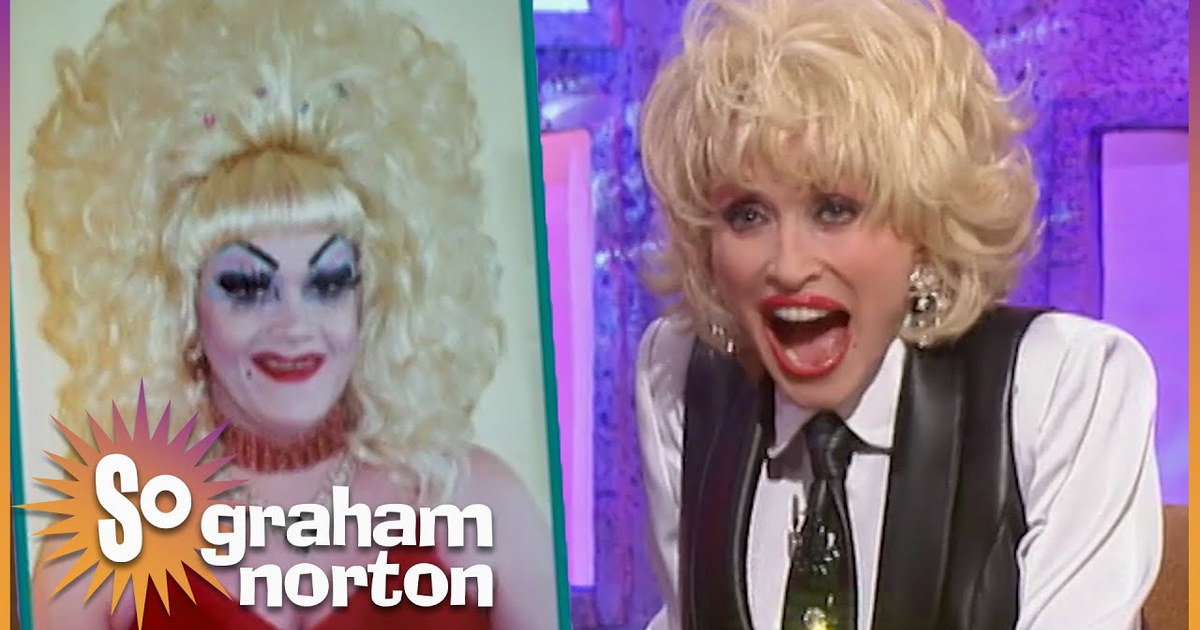
'If I hadn't been a girl, I'd have been a drag queen for sure,' she says earlier in the clip. That line matters. It tells you she understands impersonation from the inside. She knows what it means to build a self. She knows what it means to perform a self. So she honors the copy.
The clip circulates because it's a perfect collision. Celebrity. Fandom. The strange intimacy of impersonation. Mary thought she was talking to a peer. A fellow Dolly. A colleague in the same weird trade. She was talking to the source.
That's the twist. Not that Dolly called. That Mary's peer was Dolly. The hierarchy flips. The impersonator becomes the student. The source becomes the teacher. And the teacher is kind.
Graham Norton's format thrives on these moments. The show is a collision chamber. Celebrities sit on a couch. Stories spill. The red chair tips. A phone call can turn into a prank. The format loves the unscripted beat.
The Graham Norton Show airs on BBC One and streams on BBC iPlayer. In the States, it lands on BBC America. The set is built for collision. A couch. A red chair. A host who knows when to shut up. When Dolly sits down, the room knows the clip is already rolling.
Other talk shows have used prank calls. 'Crank Yankers' built a whole series on them. Howard Stern has made a career of the ambush. But this one is special. Dolly is both subject and participant. She's the joke and the punchline. She's the impersonated and the impersonator.
That double role is rare. Usually the celebrity surprises a fan. Or a fan surprises a celebrity. Here, the celebrity surprises a fan who impersonates her. The fan is not just a fan. She's a mirror. Dolly is not just a celebrity. She's the reflection.
The phone is the perfect prop. It's old technology. It strips away the visual. Mary cannot see the stage. She cannot see Graham's grin. She cannot see Dolly's wig. She only has the voice. And the voice is the thing she knows best. That's why the reveal lands so hard.
If it were a video call, Mary would know in a second. The face would give it away. The phone forces her to trust her ear. And her ear is good. That's the tragedy and the comedy. She's good enough to be fooled by the real thing.
Dolly's filmography is full of performances that hinge on that same warmth. '9 to 5' turns office revenge into a buddy comedy. 'The Best Little Whorehouse in Texas' (1982, Colin Higgins, 114 minutes) lets her sing and smirk. 'Straight Talk' (1992, Barnet Kellman, 91 minutes) puts her on a radio show. 'Joyful Noise' (2012, Todd Graff, 118 minutes) puts her in a choir. She's always the voice that cuts through.
'Dolly Parton's Heartstrings' (Netflix, 2019) anthologizes her songs. 'Dolly Parton: Here I Am' (2019, Francis Whately) documents the myth. But this clip is better than any documentary. It's a live demonstration. It shows how the myth works on a real person in real time.
Mary's 'oh my god' is the sound of the myth becoming real. It's not a scream. It's a surrender. She stops performing. She stops trying to be Dolly. She becomes Mary again. That's the arc. That's the cut.
The applause after the duet is not just for the singing. It's for the surrender. It's for the moment a fan gets to meet the source. It's for the generosity of the source. Dolly could have stayed silent. She could have let Graham do the reveal. She speaks up. She calls Mary by name. She asks about favorite tracks.
She asks Mary about 'Jolene.' She asks about '9 to 5.' She asks about 'Islands in the Stream.' She knows the catalog. She knows the deep cuts. She knows the song that needs a Kenny. That's the detail that kills. Dolly is not just present. She's producing the bit. She's directing the scene.
And when Mary picks 'Islands in the Stream' as the best, Dolly doesn't just accept it. She notes you need a Kenny. That's the setup. That's the trail. That's how the Kenny call becomes inevitable. The scene builds like a trailer. Beat. Beat. Beat. Then the chorus.


