Part 2
The wig discussion that follows is a masterclass in using the two-shot to your advantage. Johnny asks how many wigs she has. Dolly says, “I don’t really count… with hair pieces and wigs I probably have a couple hundred.” He asks if they’re expensive. She fires back, “Not these cheapos.” The camera stays on a medium two-shot, letting the audience see both her deadpan and his delight. That framing is crucial. A single on Dolly would isolate her as a curiosity. A single on Johnny would make him the arbiter of the joke. The two-shot makes them equals in the moment—she’s sharing the gag with him, not performing for him. And the lighting doesn’t change. The same flat key that makes Johnny look like a talk-show host makes Dolly look like a star who knows exactly what she’s doing.
The Mel Tillis joke she recounts is where the audience reaction shot becomes part of her arsenal. Dolly tells the story of Tillis stopping his show and saying, “I see we have Dolly Parton in the audience tonight,” only to follow with, “Oh, I’m sorry, that’s two baldheaded men sitting together.” The camera cuts to the audience for a reaction shot—standard talk-show grammar. But here it reinforces that the joke lands because Dolly owns it. She’s not the butt of the joke; she’s the one telling it, and the audience laughter is directed at the absurdity, not at her body. The cutaway to the audience is a release valve, but it’s also a confirmation: the crowd is with her, not against her.
Then there’s the Barbara Walters reference. Dolly mentions that Walters asked her the same questions. This is a meta-moment—she’s acknowledging the repetitive nature of celebrity interviews while still playing along. The lighting doesn’t change, but her posture does: she leans back, crosses her legs, signals comfort. That’s a physical cue to the camera operators. She’s not tensing up; she’s settling in. The frame stays wide enough to see her body language, and the message is clear: she’s been here before, she knows the drill, and she’s still the one in charge.
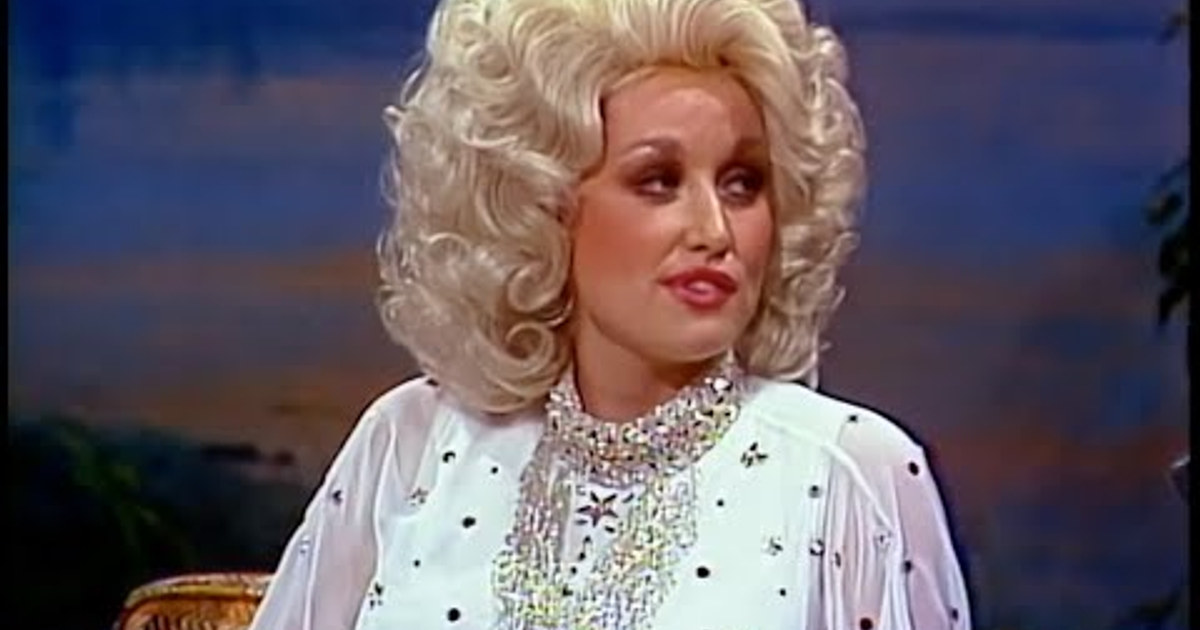
And then Johnny stumbles into the “are they real?” question. Dolly deflects with humor, then delivers the line: “I usually just say they are mine, I bought and paid good money for these.” The camera holds a tight close-up on her face—no cutaway to Johnny. That’s a directorial choice to let her own the moment. In a typical talk-show setup, you’d cut to the host for his reaction, but here the director stays on Dolly. The close-up is likely on the 10:1 zoom at the long end, which compresses her features slightly and throws the background into a soft blur. It’s flattering, but it also isolates her—she’s alone in the frame, in control. The background blur removes the set, the audience, even Johnny. It’s just her, and she’s not blinking.
That close-up is a technical decision that has ideological weight. By keeping the frame on Dolly, the director allows her to define the terms of the joke. She’s not the object of the question; she’s the subject of the answer. And the lens choice—the long end of the zoom—does something subtle: it compresses the depth, making her face the only thing in focus. The audience is a wash of color behind her. She’s the anchor. In a decade where female performers were often framed as decorative, this is a quiet act of rebellion.
The Christmas context adds another layer. Johnny jokes about needing money, and Dolly gives him the book. The prop business is staged, but the timing is impeccable. The camera operators had to be ready for the handoff—a classic two-shot to close-up to reaction shot sequence. That sequence is the visual equivalent of a joke setup and punchline. The two-shot establishes the exchange, the close-up of the book delivers the punchline, and the reaction shot of Johnny (or the audience) confirms the laugh. It’s choreography, and Dolly is the choreographer.
What makes this appearance so enduring is that Dolly never loses control of the frame. She uses the tools of the medium—the close-up, the two-shot, the reaction shot—to her advantage. She’s not fighting the camera; she’s directing it. And that’s why, nearly fifty years later, we’re still watching. The wig, the jokes, the close-up: they’re all part of a strategy that turned a potential spectacle into a showcase of agency.
So the next time you watch a talk show, pay attention to who gets the close-up. In 1977, Dolly Parton made sure it was her.


