Part 1
The Set Was the Co-Star: How The Tonight Show's Visual Grammar Framed Dolly Parton in 1977
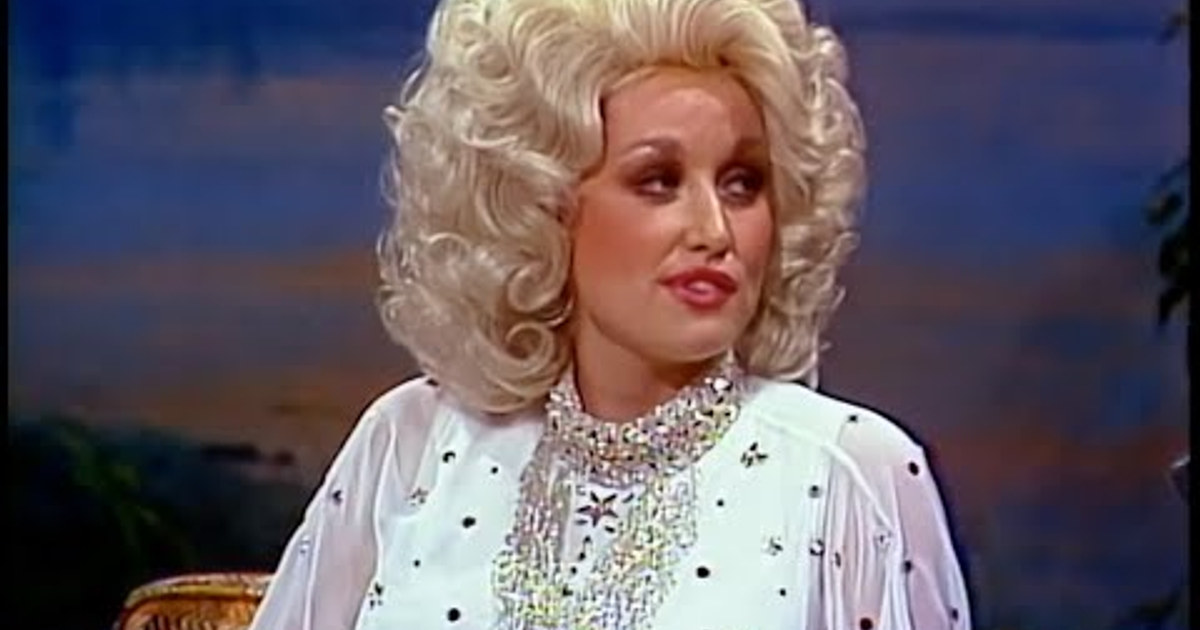
Dolly Parton walks out to Johnny Carson's applause in 1977, and the camera holds a beat too long on her wig—a deliberate choice that tells us everything about how 1970s TV treated female stars. That extra second isn't a mistake. It's a visual thesis statement: before she says a word, the frame has already defined her by her hair.
This 1977 Tonight Show appearance isn't just a charming interview; it's a masterclass in how lighting, lens choice, and blocking can either amplify or undermine a performer's self-authored image. As a cinematographer who's shot second-unit, I'll argue the technical crew here mostly got it right—and the moments they didn't are just as instructive.
NBC's Burbank Studio 1 was a factory of intimacy. Johnny Carson's custom-built set featured warm tungsten practicals—table lamps, a desk lamp, all glowing at around 2800K—that gave the space a living-room feel. The standard three-camera setup: two pedestal cameras for medium shots, one on a dolly for the two-shot. The pedestals were Mitchell BNCs, reliable workhorses that could hold a tight frame without a jitter. The dolly camera was usually a smaller, lighter rig—often an Arriflex 35 IIC—so the operator could glide in for reactions without knocking over a lamp.
The dominant lens of the era was the Angenieux 10:1 zoom, often parked at f/2.8. That zoom gave close-ups a soft, slightly hazy look—not quite dreamy, but forgiving. Compare that to Dick Cavett's set, which used harder, more contrasty lighting. Cavett's key was often a bare 1K fresnel with little fill, carving faces with shadow. Carson's was flattering, almost forgiving. For a guest like Dolly Parton, that difference mattered. Cavett's lighting would have emphasized the architecture of her face; Carson's wrapped her in warmth.
The lighting plot was classic three-point, but executed with a soft touch. Key from a 2K fresnel at 45 degrees, a soft fill from a scoop, and a hair light that catches Dolly's wig just enough to create a halo. That halo isn't accidental—it's the visual equivalent of her persona. The hair light was likely a 1K fresnel with a diffusion frame, aimed at the back of her head. It separated her from the dark backdrop and made the wig glow like a crown. In 1977, that was a choice. The crew could have flagged it off. They didn't.
Dolly's outfit—the low-cut dress, the wig, the makeup—interacted with the set in ways that required costume and lighting to collaborate. Sequins are a nightmare for exposure. They blow out highlights and create specular hotspots that can read as video noise. The lighting team had to avoid direct key on the sequins while keeping her face readable. That meant a slightly softer key, maybe a layer of 216 diffusion on the fresnel, and careful positioning of the fill to wrap around the dress without hitting the sparkle. The result: she shimmers, but her eyes stay sharp.
Then there's the guest host beat. Charles Nelson Reilly fills in for Carson, and the camera blocks him wider, more static. Reilly was a brilliant performer, but the visual hierarchy is clear: he's the substitute, the placeholder. When Dolly arrives, the dolly camera comes alive. It pushes in, pulls out, finds the two-shot, then cuts to a tight single. The dynamism isn't just about her star power; it's about the crew's instinct to move when the real subject is on set.
This visual grammar didn't happen by accident. It was the product of a specific era in broadcast television, when variety shows and talk shows were shot on film-like video with a cinematic sensibility. The Tonight Show under Carson was directed by Bobby Quinn, who understood that the camera should be a guest at the party, not a wallflower. Quinn's team knew when to hold a shot and when to cut. That beat too long on the wig? That was Quinn letting the audience drink her in.
[[AD]]
The technical setup framed a conversation that was just as carefully constructed. Next section: the wig as prop, the self-deprecation as strategy.
[[VIDEO]]
The Wig, the Jokes, and the Close-Up: How Dolly Parton Controlled Her Own Image Under Carson's Lights
There’s a moment in Dolly Parton’s 1977 Tonight Show appearance that every cinematographer should study. She reaches into a bag and hands Johnny Carson a book. The title? What I Know About Fancy Clothes, Wigs and Makeup. The camera cuts to a tight close-up of the cover, then snaps back to her face. That cut is the whole story. In a single edit, the control of the image shifts from the host to the guest. Dolly didn’t just survive the male gaze of 1970s television; she preempted it by making herself the first and best joke. The technical crew’s close-ups and reaction shots become complicit in her strategy, not her exploitation.
Think about the visual grammar of The Tonight Show in that era. You’re shooting on 2-inch quad tape, lighting with a flat, high-key setup that flatters everyone but flattens depth. The main camera is usually a pedestal-mounted workhorse with a 10:1 zoom, and the operator is looking for the reaction, the laugh, the moment. When Dolly hands over that prop book, the director has a choice: stay wide and let the audience see the bit, or punch in on the object. They punch in. That close-up of the book is a visual quote—it tells you Dolly is in on the joke before Johnny even opens his mouth. Then the cut back to her face, deadpan, waiting. She’s not the punchline; she’s the one who wrote it.


