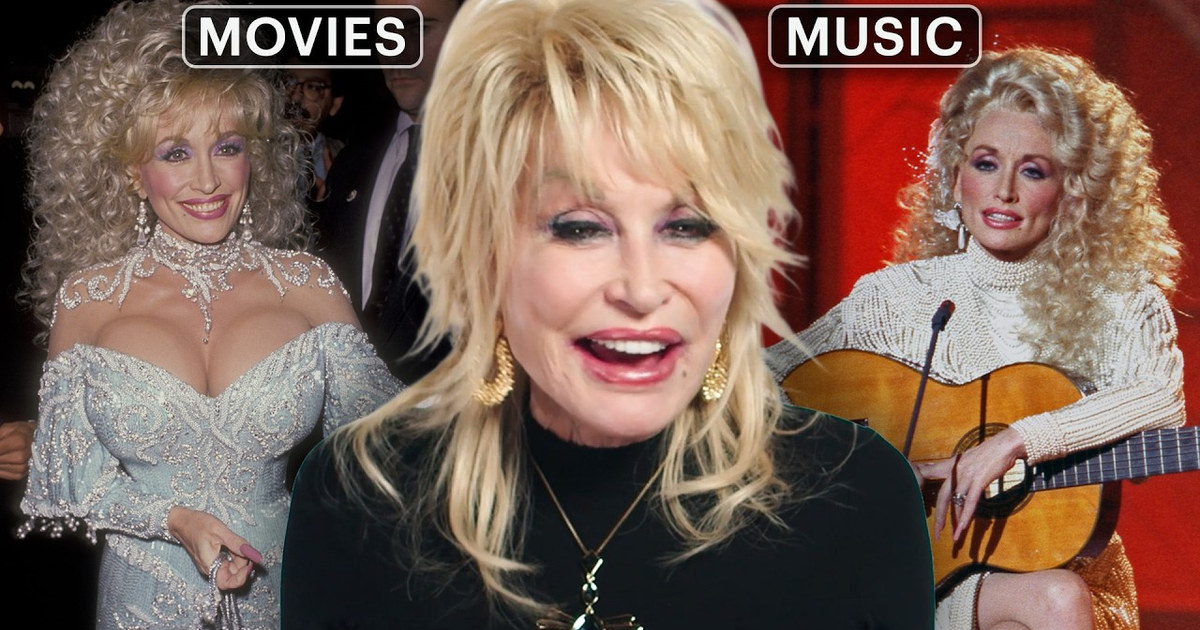
Part 5
You can watch that blueprint get executed in 110 minutes. Dumplin' (2018), directed by Anne Fletcher for Netflix, stars Danielle Macdonald as a fat teenager in small-town Texas who enters a local beauty pageant in full Dolly drag — not to win it, but to put it on trial. Jennifer Aniston plays her former-beauty-queen mother, and Dolly executive-produced the soundtrack and appears as herself. It's the rare movie about self-invention that understands the invention is the point.
The same instinct drives Dolly Parton's Heartstrings (2019), the eight-episode Netflix anthology that spins each installment out of a song — "Jolene," "These Old Bones," "JJ Sneed." Not every hour lands. But the premise is the argument: a discography is a wardrobe, and you're allowed to try on somebody else's.
Then came Rockstar, released that November in 2023 on Butterfly Records: thirty tracks, a rock album nobody demanded, stacked with Paul McCartney and Ringo Starr trading lines on "Let It Be," Miley Cyrus on "Wrecking Ball," plus Sting, Stevie Nicks, Steven Tyler, Sheryl Crow, Lizzo, Chris Stapleton and Elton John. It debuted at No. 3 on the Billboard 200 — the highest-charting album of a career that began in 1967 — and topped the country and rock charts at once.
A year earlier, the Rock & Roll Hall of Fame had come calling. She asked them to withdraw her name, insisting she hadn't earned it. The Hall declined to take the hint and inducted her anyway in November 2022. So she answered the only way she knew how: she went out and made an actual rock record. Hand Dolly Parton a category and she will become undeniable inside it.
Now send her the bill. She has described the wigs as "more like a handicap" — a thing that frees you and then quietly starts owning you. Fifty years of one silhouette. Every airport, every funeral, every 6 a.m. grocery run in a Tennessee November: same hair, same nails, same face. That isn't vanity. That's a costume with a lease that never expires, worn by someone who knows that the moment she breaks character, the character is what people will decide was fake.
Her own summary of the arrangement is that it's hard to be a diamond in a rhinestone world. Sit with that. The world is cheap, loud, heavily bedazzled and mildly fraudulent. To be precious inside it, you have to out-sparkle the entire room — and then get up and out-sparkle it again tomorrow. She's also said it costs a lot of money to look this cheap. Both lines are true. Neither is a complaint.
And the machine ages in strange ways. A wig doesn't gray unless you decide it should. It doesn't thin. It is, in the most literal sense, better than the thing it replaced — a portrait of a woman who has elected to stop negotiating with time in public. Dolly has spent six decades promising she looks gaudy, flamboyant and fun while the body underneath does what all bodies do. The look is armor, and armor doesn't sag.
The pressure is that she can never set it down. Plenty of icons have a public face; Dolly's is continuous, from the stage to the red carpet to the Dollywood gate. Wigs as handicap, wigs as freedom — it depends entirely on whether you were the one who chose them. She chose. Every single morning for fifty years, she chose again.
That's the thesis of a documentary that arrived just as the wig became an institution. Paris Is Burning (1990), Jennie Livingston's 78-minute portrait of New York's ballroom scene, is a movie about people who built entire selves out of scraps and sparkle because the world had assigned them nothing. Its categories — realness, executive realness, high fashion — are audits: can you pass? Its stars, Dorian Corey and Venus Xtravaganza among them, know that passing isn't lying. It's proof of craft.
Pose (2018–2021), the FX drama Steven Canals created with Ryan Murphy and Brad Falchuk across three seasons and 26 episodes, carried the same idea into prime time — Billy Porter's Pray Tell, Mj Rodriguez's Blanca, houses of chosen family replacing the ones that failed. In both, style is survival, and self-invention isn't a lie told to the world. It's a truth told about yourself. Dolly got there first, from a two-room cabin in Sevier County — and she got there in heels.
She has also been, quietly and stubbornly, a friend to the people who took her look and ran with it. She was a drag fixture long before drag was profitable, an icon through the worst of the AIDS crisis, and in 2020 she put a million dollars into Vanderbilt's COVID vaccine research. The allyship isn't a press release. It's a track record.
So here's where the question bends. "Is Dolly real?" was always the wrong ask. Better: what does her performance of fake teach us about being real? The answer is that realness isn't a substance you're born holding. It's a practice. A decision made every morning in front of a mirror with a brush in your hand, repeated until it becomes the face you actually have.
The wig isn't a cover-up. It's a confession. It says: this is what I want to look like, and I want it badly enough to build it. And the woman explaining that her hair won't behave and her hands are stubby is being more honest about who she is than most celebrities manage across an entire memoir.
"The higher the hair, the closer to God," country singers used to say, and Dolly insists they really believed it. You don't have to share the theology to see what it's reaching for. The higher you stack the thing you made, the closer you get to the person you meant. She's been reaching for seventy years. The reach is the truth.
That's the legacy: not a hairstyle but a method. Dumplin' gets it, Heartstrings gets it, Rockstar is it — every new genre, new audience, new decade, rebuilt from the ground up and topped with a tower. Queer kids in ballrooms and drag bars and TikTok comment sections never needed her permission. They took the blueprint anyway.
Which leaves one enormous wing of the Parton empire untouched: the songs. The woman who writes "Jolene" and "I Will Always Love You" and turns a Nashville songwriting habit into Dollywood, a production company and a fortune she never sold. Next time: the business of Dolly, and the pen that built it. Bring a calculator.


