Part 3
Dolly has never been shy about the mechanics of it. She's said plainly that her hair "don't do what I wanted to," so she wears wigs. She can still have it all, even if it's fake. That's not a confession — that's a manifesto. In the 1970s, that philosophy went into overdrive.
[[VIDEO]]
The woman behind the volume was her hairdresser, Colleen Owens, who helped take Dolly's hair from merely big to larger than life. We're talking curls that looked like they'd been piped on with a pastry bag. Whipped cream curls, towering and glossy and absolutely unbothered by gravity. If you've ever wondered how a human head supports that much hair, the answer is: carefully, and with a lot of help.
But the hair wasn't a gimmick. It was a solution. Dolly has talked about how she used fashion to hide her weight and to feel her space in the world. When you're short — and she'll be the first to tell you she is — you learn to take up room in other ways. High heels. Long nails. And hair that enters the room a full three seconds before you do. Every inch of that bouffant was armor.
She's even joked that her daddy raised bees, and some of those hairdos looked like a beehive — like a family of something could live under there. She's not wrong. But that self-awareness is exactly why it works. Dolly knows precisely how ridiculous it all is, and she does it anyway, on purpose, with a wink.
Now, the clothes. Dolly's 1970s style is best described as gaudy but flowy. She's said she likes fashions that are gaudy, flamboyant, fun, comfortable, and noticeable. That's a perfect five-point checklist, and she hit every single one. The sleeves were enormous. The collars were wide. The fabric moved when she moved, which mattered because she was never standing still.
This is a crucial detail that gets lost when people just call her "flashy." The clothes had to work. She was on stage, playing guitar, singing her heart out, and those flowing sleeves and loose silhouettes let her do all of it. Comfort wasn't the enemy of glamour — it was the foundation of it. She dressed according to her moods, and her mood was usually: more.
And then there are the rhinestones. For those, we have to talk about Porter Wagoner and Rose Maddox. Porter, her duet partner and the man who gave her a national platform, was famous for his rhinestone suits — those dazzling, Nudie Cohn-designed confections that looked like a jukebox exploded in the best possible way. Rose Maddox, the fiery country singer, wore them too. Young Dolly saw that and thought: I want that. Forever.
She got it. The rhinestones became her signature, her shorthand, her whole visual language. And she gave us the line that sums up her entire relationship with glamour: "It's hard to be a diamond in a rhinestone world." Think about that for a second. She's not complaining. She's telling you she knows exactly what she is — and she's still going to shine harder than everything around her.
Here's where the 1970s really get interesting. Dolly didn't keep the rhinestones locked in a stage wardrobe. She started folding them into her everyday look. Frills, sparkle, and shine stopped being costumes and became just... her. The show clothes and the real clothes merged. By the end of the decade, there was no off-duty Dolly. There was only Dolly.
That's the thing about this stop on the tour. Most performers have a stage persona and a private self. Dolly dissolved the border. The wigs, the nails, the heels, the rhinestones — she's been upfront that she wears them because they make her feel like herself. Not a character. Herself. The 1970s is the decade that decision hardened into a permanent aesthetic.
And it all traces back further than you'd think. Remember those feed sack dresses from the last stop? Dolly has laughed about how she and her siblings wore sack dresses their whole lives because that's what her mom made their clothes from. So when shift dresses — sack dresses — became high fashion in the 1960s and '70s, she thought it was hilarious. She'd been wearing that look since childhood. The difference was the rhinestones on top.
That's the arc of this decade in one image: a girl who wore feed sacks, now draped in sequins and frills, hair scraping the ceiling, refusing to shrink. She took the poverty of her childhood and turned it into a punchline, then turned the punchline into a crown.
So who else could turn a feed sack into a rhinestone empire? Who else could take a beehive, a wig, a pair of acrylic nails, and a Porter Wagoner suit, and build a look so singular that fifty years later we're still standing here, craning our necks, trying to see the top of it?
Nobody. That's who. And the 1970s is the decade that proved it.
[[AD]]
Stop 4: The 1980s and Beyond — Tight Curls and Timeless Glamour
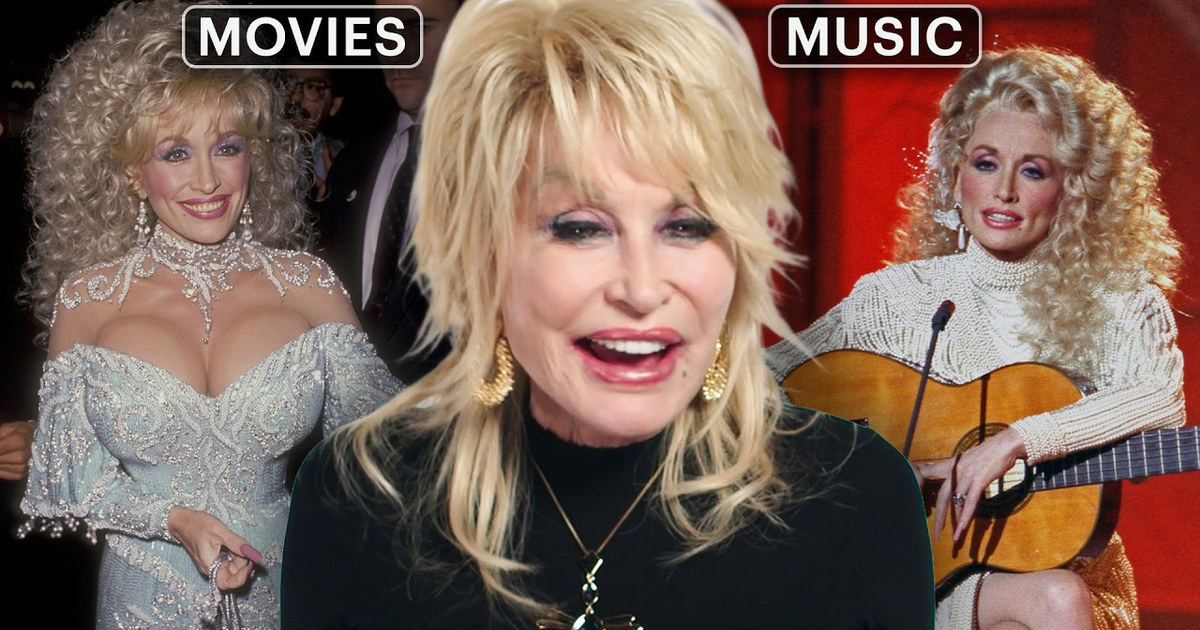
Notice the curls first. Not the teased, gravity-defying bouffant of the seventies, but a cascade of tight, structured ringlets that framed her face like a halo. This was the 1980s Dolly—still towering, still blonde, but with a texture that felt new. It was a departure, yes, but never a betrayal. The height remained. The sparkle remained. The Dolly remained.


