Part 1
Stop 1: The Butterfly and the Belly — Reading the Opening Photo
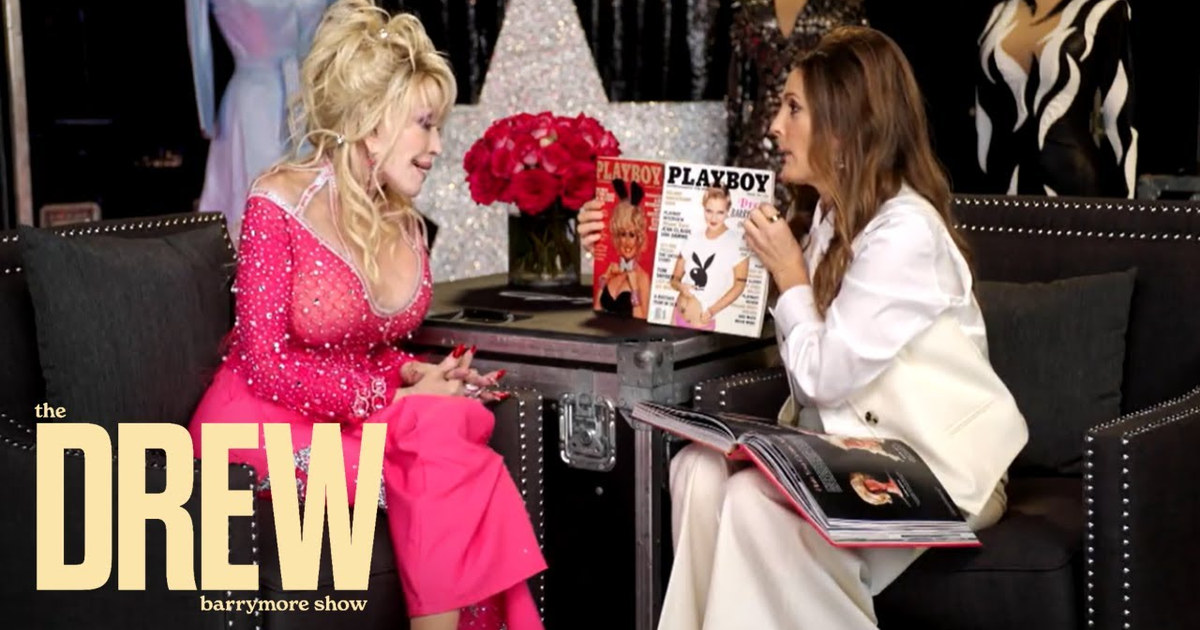
Before we go anywhere else, look at the butterfly. In the opening seconds of this conversation, Dolly Parton points at the image on the screen — the other person's little butterfly, the little belly — and then at her own. "I had on less clothes than you," she laughs. You might breeze past that. Don't. That butterfly is not decoration. It's a signature.
Butterflies meant so much to Dolly as a kid, and they've been a motif in her life and her look ever since. So when she spots one on someone else's body in an old photo, she isn't just making small talk. She's recognizing a thread. And that thread runs straight into the rest of this conversation — identity, permission, and the quiet refusal to live on somebody else's schedule.
Here's the part that trips people up. The other person says, "I was three years old when I did my first" — meaning Dolly did her first Playboy cover when this person was three. Dolly was on the cover of Playboy in 1978. She did it again in 2021, at 75, in the iconic bunny outfit. The other person was three years old at the time of that first cover. They didn't pose. They were a toddler. The photo they're looking at together is a snapshot from that era — a kid in a butterfly top, a belly out, and Dolly in full come-hither mode on a magazine cover that became a piece of pop history.
So why start here? Because the butterfly is the first clue that Dolly has always known exactly who she is. She didn't discover her signature later. She was a kid in the Smoky Mountains of Tennessee, one of twelve children, dreaming in butterflies and rhinestones. By the time she was on the cover of Playboy in 1978, she was already fully formed — the hair, the wit, the boundary-setting. The 2021 cover wasn't a comeback. It was a victory lap.
And notice how she handles the photo. She doesn't flinch. She doesn't apologize for the "come hither" look. She owns it, then immediately turns the attention back to the other person: "Oh, you look cute." That's the move. That's the whole conversation in miniature. Dolly can be the biggest star in the room and still make you feel like the main event. It's not a trick. It's a discipline.
The other person says it's scary to even claim connection with Dolly — the hair, the butterflies, the Playboy, the encouragement for everyone to be who they truly are. Dolly's response is a masterclass in deflection and generosity: "There is no one who doesn't love you on the planet." Then she catches herself. "Oh, there is. But we don't want to hear about them." That's Dolly in a nutshell. Warm, but not naive. She knows the haters exist. She just refuses to give them the tour.
This is a conversation about identity, permission, and refusing the hamster wheel. The butterfly is where it starts. It's a tiny motif that unlocks everything else — the fact machine, the low-tech life, the crew, the guilt-free no. Dolly has been Dolly since before most of us were born. The butterfly just proves it was always there.
So before we move on, sit with that image. A three-year-old in a butterfly top. A superstar in a bunny suit. Two people connected by a symbol that means childhood, transformation, and a signature that can't be faked. Dolly looks at it and sees herself. She looks at the other person and sees a kindred spirit. That's the first stop on this tour. And it's the reason the rest of the conversation even matters.
Stop 2: 'I'm a Low-Tech Girl in a High-Tech World' — The Fact Machine and the Phone She Won't Text On
Now walk with me to the second stop on this tour. You've seen the butterfly. You've seen the belly. Now look at what's in her hand — or rather, what isn't. No smartphone. No glowing screen. Just a small, old-school device she calls her "fact machine." It's the tool she calls her favorite thing in the world, because it delivers the written word "in an instant." That's the whole confession, right there. Dolly Parton is not anti-technology. She's selectively technological. And that distinction is the entire point.
Here's what she says, plain as day: "I'm a low-tech girl in a high-tech world." She doesn't text. She doesn't email. She doesn't want to talk to everybody who wants to talk to her. And before you clutch your pearls — she's not confused about this. She knows she could learn. She says so herself: "I'm certainly not a stupid person. I could learn it if I wanted to." She just doesn't want to. That's not a limitation. That's a decision.
Think about how radical that sounds in 2024. We live in a world where a read receipt is a moral judgment. Where "sorry for the late reply" is a reflex. Where being unreachable for six hours feels like a crime. Dolly looked at all of that and said: no thank you. She surrounds herself with high-tech people — her crew, her management, her team — and lets them handle the digital noise. She keeps her own tools simple. The fact machine stays. The texting stays out.


