Part 2
[[AD]]
Memory Leaks and Checkmates: Improvisation Without an Event Bus
Look beneath the hood of that quarter bag, however, and you find a masterclass in dynamic conversational routing. During one exchange, Ferguson and Paulson stall out in a conversational cul-de-sac over where she was born. Ferguson asks her origin; Paulson reminds him she already answered that question on a prior broadcast, or perhaps five minutes earlier. Ferguson feigns indignation: 'What the hell, Sarah, why are you being mean to me?'
In a poorly calibrated talk show, a forgotten detail feels like a syntax error—an awkward break in the illusion of effortless celebrity camaraderie. Here, both performers deliberately preserve the error state. Paulson makes a swift, aggressive physical gesture—miming a physical checkmate directly against Ferguson’s palm. Ferguson reads the mime in real time, pauses his delivery, and acknowledges the tactical defeat before redirecting the stream toward marine predators.
This is error handling at the highest human level. Instead of trying to suppress conversational glitches, Ferguson and Paulson promote them to core features of the segment. When Paulson notes she lives a quiet, shut-in life watching reality television—specifically sobbing at *American Idol* and tracking *The Real Housewives*—Ferguson doesn't mock her from an ivory tower. He joins her in the basement, discussing shark attacks at the Farallon Islands off San Francisco and the murky fifteen-mile kill zone where great whites congregate.
[[AD]]
The Promotional Trap: Horror Stories, Crab Apples, and Fruit Dunking
Eventually, the industrial reality of television must surface: the guest has a project to sell. In this case, Paulson was on deck to promote *American Horror Story: Asylum*, where she portrayed the intrepid, put-upon journalist Lana Winters. Any other show would play a thirty-second clip of electroshock therapy or psychiatric torment, cut back to the couch, and solicit an earnest monologue about the grueling psychological demands of Ryan Murphy’s set.
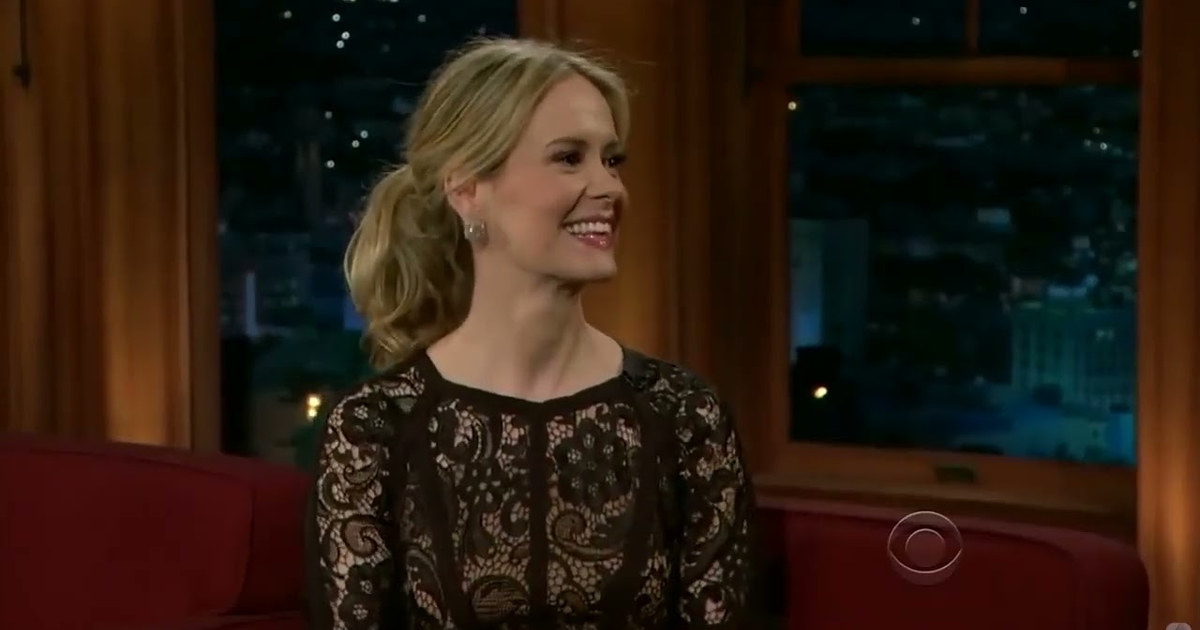
Ferguson bypasses that entire framework. The promotional transition starts because Jeff Goldblum, the preceding guest leaving the soundstage, inexplicably gifted Paulson a microscopic piece of fruit—a diminutive crab apple. Paulson sits down and, instead of delivering her logline, demands Ferguson's coffee cup so she can hook the apple onto its rim, eventually dunking it straight into the host's beverage.
Genre viewers get an unforgettable television image: an A-list dramatic star dunking tiny ornamental produce into a host’s mug while joking about her character being nicknamed 'Lana Banana.' The tone oscillates violently between gothic psychological dread and breakfast-table slapstick. It delivers the essential commercial payload—viewers clearly register the show title, network, and premiere date—without ever feeling like an advertisement.
[[AD]]
The State Machine of Geoff Peterson: Josh Robert Thompson’s Telemetry
You cannot analyze this desk dynamic without auditing the animatronic skeleton standing stage left. Geoff Peterson, designed by Grant Imahara and voiced live off-stage by Josh Robert Thompson, functioned not as a scripted sidekick, but as an asynchronous coprocessor. He injected ambient audio cues, non-sequiturs, and biting punchlines directly into the room without Ferguson needing to yield focal priority.
Watch the 'What's In My Box?' game play out. Ferguson instructs Paulson that he has conceptualized an object inside an imaginary mental container. 'I don't know what's in it,' Ferguson announces. 'Only Jeff knows what's in it.' Ferguson taps into the skeleton’s audio channel: 'Jeff, do you feel the box?' Geoff responds in real time with an affirmative hum, maintaining an entirely fictional consensus reality between three distinct human nodes.
When Paulson attempts to inspect the box, the payoff relies on a shared memory call that has zero connection to reality: 'We would have accepted cream.' The joke has no logical premise; it is an internal reference compile error that pays off purely because all three entities—Ferguson, Paulson, and Thompson—commit to the logic of the non-existent game with absolute fidelity.
[[AD]]
The Kissing Face Calibration: Micro-Expressions as Interface
One of the most revealing technical moments across these tapings occurs during an impromptu breakdown of courtship mechanics. Ferguson observes Paulson’s expression and challenges her on what her face looks like immediately prior to physical intimacy. What ensues is a rapid, granular dissection of the 'kissing face'—a kinetic sequence of head tilts, closed eyelids, and pursed lips that both performers execute and critique like video game animators reviewing motion-capture telemetry.
'Imagine kissing a fish,' Ferguson declares, forcing an exaggerated pucker that Paulson instantly evaluates. The bit extends into an existential riff on dating, social anxiety, and whether sudden head-tilting during ordinary conversation should be classified as a conversational threat vector. Paulson laments that her demonstration explains why she is single; Ferguson counters by referencing his own dangerously self-deprecating habits.
This sequence functions because both individuals possess extraordinary comedic timing and absolute comfort with unflattering physical expressions. Neither is attempting to look glamorous for an Instagram screengrab. They are utilizing their own facial structures as modular instruments to build a rhythmically sound comedic sketch entirely out of thin air.
[[AD]]
Deconstructing Social Media: The Early Days of Hashtag Culture
Toward the later segments of their encounters, the dialogue drifts toward a nascent technological phenomenon: the rise of front-facing camera self-portraits, newly cataloged by the broader culture under the term 'selfie.' Paulson expresses deep visceral discomfort with the emerging social convention of 'Hashtag Selfie' posts, branding it an overt exercise in everyday narcissism.
Ferguson, working with his characteristic mock-luddite persona, examines the mechanic through the lens of modern mobile hardware. He probes whether the device in question is 'the iPhone—one of the many products available,' turning standard commercial sponsor anxiety into an open punchline. When Paulson leaves makeup residue on his suit trousers from laughing, the physical artifact becomes immediate evidence of the broadcast's tactile reality.
The exchange captures a specific transition point in media history. The talk show format was bracing for the era of social media clips, viral TikTok cuts, and polished influencer self-promotion. Yet here were two masters of the old medium deliberately refusing the pristine veneer of internet-ready curation, opting instead to sweat on set, mock technological vanity, and leave makeup smudges on wool trousers.
[[VIDEO]]
The Grand Compilation: Why Both Audiences Win
When you zoom out from the individual bits—the pineapples, the harmonica blows, the shark phobias, the Desmond Tutu Peabody name-drops—you realize why this dynamic continues to circulate on social feeds and archive channels more than a decade later. It solves the foundational trilemma of broadcast entertainment: it is fast, it is genuine, and it is structurally inventive.
For the genre fan, Sarah Paulson remains the ultimate talk-show sparring partner. She doesn't arrive with defensive PR armor; she arrives ready to play in the sandbox, willing to be the butt of the joke or the architect of the madness. She makes Ferguson funnier, and Ferguson draws out an unhinged, electric spontaneity from her that conventional junket interviews routinely stifle.
For the craft obsessive, these segments represent a lost golden age of unscripted latency management. Ferguson proved that if you remove the scaffolding—the cue cards, the pre-interviews, the sterile PR talking points—and replace it with two sharp minds operating on active listening and shared vulnerability, the resulting program compiles without a single fatal error.
In our next breakdown, we’ll dive deeper into the late-night architecture of Studio 58, tracing how Ferguson's deliberate sabotage of standard broadcast protocols reshaped the mechanics of modern digital comedy. Stay tuned, keep your quarters in the bag, and never blow into the box.


