Part 1
Every late-night broadcast attracts two completely distinct profiles of viewer, whether the production staff wants to admit it or not. The first is the genre partisan. They tune in for the exact payload promised by the marquee: the high-octane banter, the promotional clips for upcoming cable prestige dramas, the self-effacing wardrobe jokes, and the spectacle of a movie star sweating under studio lighting. They want the television machine to perform its signature routine, deliver its endorphin hit, and reset the buffer before midnight.
The second viewer is the craft mechanic. This is the person who watches the frame with one eye permanently squinted at the seams. They do not care about the promotional junket for FX's latest season; they care about latency, comedic throughput, and behavioral ergonomics. They want to see how two human beings manipulate the unwritten protocols of an unscripted medium without crashing the runtime environment. For this viewer, television is simply real-time distributed systems engineering performed under three-point lighting.
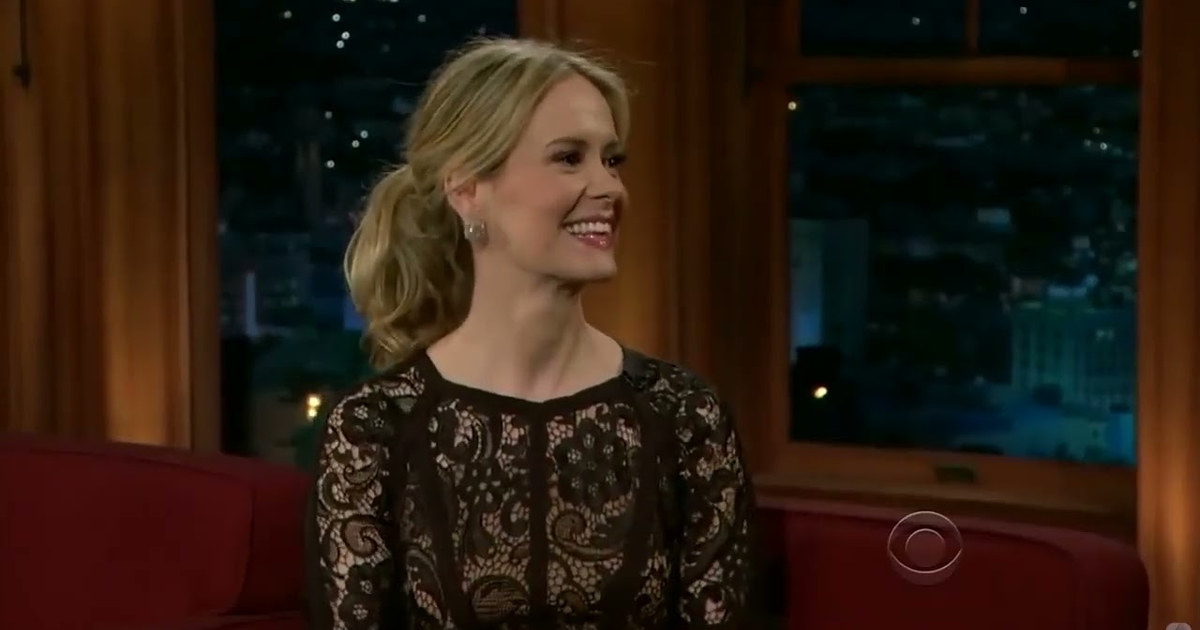
When Sarah Paulson stepped onto the rickety, deliberately chaotic set of CBS’s Studio 58 to sit across from Craig Ferguson, both of these audiences received everything they came for. Over a sequence of repeat appearances captured in their peak era, the Scottish host and the Emmy-winning performer engaged in what might be the purest demonstration of improvisational network television ever committed to tape. It is an absolute rush to watch, but it is an even greater thrill to reverse-engineer.
[[AD]]
The Syntax of the Junket: Wardrobe, Tongues, and Giraffes
From a purely genre-focused perspective, an interview of this caliber opens with familiar late-night staples: appearance evaluation, mild flattery, and immediate social disarming. Paulson walks in wearing a structured outfit that Ferguson immediately flags for its aesthetic ambiguity. Rather than falling back on the sterile 'you look fantastic' platitudes favored by traditional network anchors, Ferguson isolates an aesthetic contradiction: the dress possesses an unmistakable vintage air, yet Paulson confirms it is brand-new fabric treated to mimic wear.
The conversation does not linger on fashion house credits. Instead, it instantly degenerates into an interrogation of biological trivia. Ferguson steers straight into giraffes, citing an eighteen-inch tongue length with the casual precision of someone reading system logs. What follows is classic junket entertainment: an escalating contest of physical anomalies where Paulson demonstrates that she can touch her nose with her own tongue, complete with live audience ovation.
To the genre fan, this is gold-tier television. You have an elite dramatic actress—someone known for bearing the psychological scars of Ryan Murphy’s bleakest television universes—deliberately making an amphibian face on network television to pop a studio crowd. It scratches every itch of celebrity accessibility while preserving the manic spontaneity that made Ferguson’s tenure on CBS an enduring internet legend.
[[AD]]
Refactoring Late Night: Ferguson’s Infinite While-Loop
Now let us look at the underlying architecture. Standard late-night television operates like a waterfall development model. A talent producer sits down with the guest forty-eight hours prior to taping, collects three pre-approved anecdotes, writes them into clear cue cards, and hands the host an index card containing rigid trigger phrases. The host asks Question A, the guest executes Anecdote A, the studio band hits an eight-bar transition, and the sequence restarts with Question B.
Ferguson famously tore up those cards at the beginning of every segment. In computational terms, he replaced a deterministic linear script with an event-driven loop operating on pure shared memory. Notice how he processes Paulson’s early admission of anxiety. When she confesses her palms are wet, standard hosts would deploy a comforting cliché to steer back to the topic sheet. Ferguson immediately hands her a tactile solution: an invitation to physically dry off, followed by an immediate pivot into zoo confinement ethics.
The craft here lies in conversational pipelining. Paulson mentions she dislikes zoos because cages make her sad. Ferguson suggests an African safari. Paulson fires back that she refuses to fly. Ferguson reveals that he conquered his own fear of aviation by earning a private pilot’s license, only to discover it simply made him 'frightened and educated.' Every single statement serves as both output for the current beat and input for the subsequent one. The latency between thought and execution is close to zero milliseconds.
[[AD]]
The Hardware Abstraction: Secretariat and the $50 Purse
If late-night comedy has physical props, Ferguson treated them like open-source hardware hacks. Backstage lurked Secretariat, an uncoordinated pantomime horse operated by two stagehands in cheap fabric, flanked by a static mounted rhinoceros head and a plastic harmonicon setup. When Paulson questions the presence of the bizarre horse backstage, Ferguson doesn't give a polite theatrical rationale; he bills it as 'the actual horse from the movie Secretariat,' claiming modern science accelerated its velocity for the silver screen.
Then comes the recurring endgame apparatus: the choice between the 'mouth organ' (a cheap harmonica still in its plastic casing) and the 'Big Cash Prize.' The cash prize is not an electronic sweepstakes; it is fifty dollars in loose quarters crammed into a canvas sack adorned with a burglar-style dollar sign. It looks like an asset pulled directly from a 1930s Fleischer Studios cartoon.
For the genre fan, the absurdity is the payoff. Watching an acclaimed performer negotiate whether she should blow into a cheap musical reed or haul five pounds of laundry change off a CBS soundstage is hilarious because it strips away all Hollywood self-seriousness. It turns the late-night guest slot into an unhinged carnival booth where the prizes are intentionally inconvenient.


