Part 2
[[AD]]
The Pistachio Mystery: Sleep as an Unsupervised Stage
Every great talk-show appearance possesses a narrative centerpiece, and Rodriguez’s nocturnal pistachio saga remains an all-time classic of late-night folklore. What makes the anecdote resonate is not merely its weirdness, but her refusal to romanticize herself. Many rising starlets would balk at presenting an image of themselves snoring on a mattress while mechanically chewing nuts in a state of chemical twilight, but Rodriguez leans into the grotesque hilarity of the scene with theatrical commitment.
The setup is mundane: the modern traveler’s desperate quest for rest, relying on a health-store cocktail of melatonin and botanical extracts to trick an overstimulated brain into submission. Ferguson immediately brands the potion as 'heroin,' puncturing the high-minded wellness jargon in an instant. Then comes the awakening. Rodriguez recreates the confusion beat by beat: the tactical panic upon opening her eyes to find her bed blanketed in sharp fragments, the sudden paranoid dread that some unseen intruder had broken into her home solely to pelt her with pistachio shells, and finally, the slow sensory realization of the salty, roasted residue lingering in her mouth.
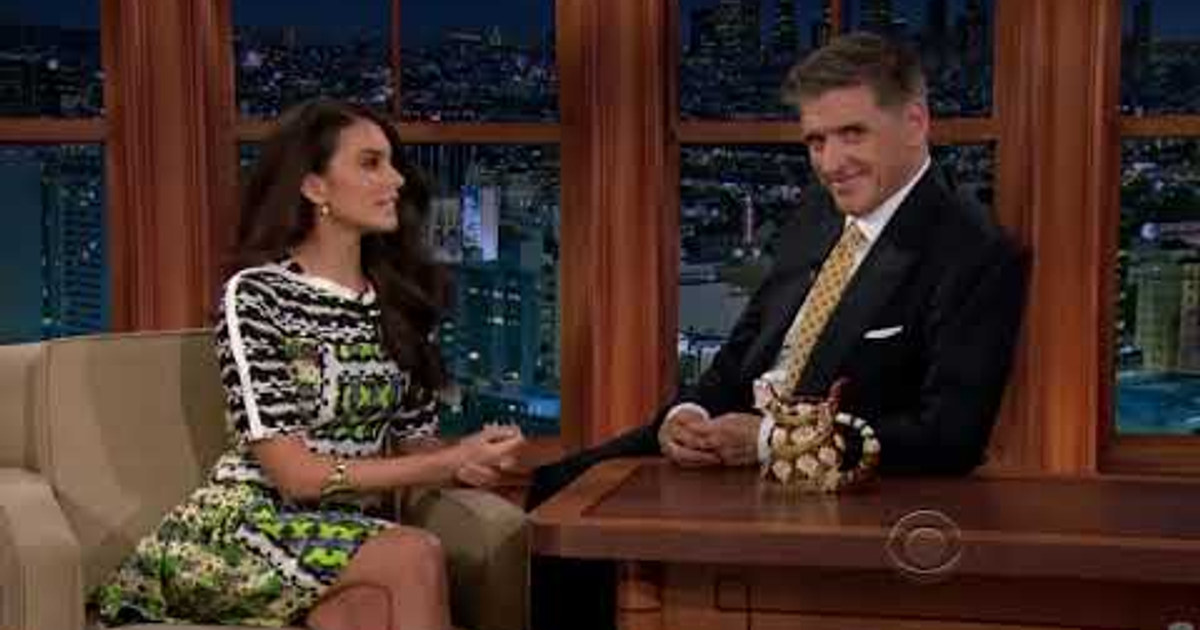
Ferguson’s reaction is a masterclass in comic escalation. Rather than offering gentle sympathy, he validates the sheer existential horror of the incident while simultaneously suggesting that she must now sleep in an empty vault devoid of sustenance. The visual of Rodriguez—immaculately styled, gleaming under studio lights—confessing to complex motor skills executed in an unconscious trance turns the sterile veneer of celebrity publicity inside out. She is not selling a brand; she is reporting from the baffling frontline of human experience.
[[AD]]
Body Horror and Podcasting: Dissecting Kevin Smith's Tusk
Eventually, even Craig Ferguson had to address the film his guests were contracted to promote, though he usually managed to treat the actual movie like an accidental interruption to a much better conversation. Yet when Rodriguez arrived to discuss Kevin Smith’s 2014 body-horror odyssey Tusk, the movie itself was far too eccentric for Ferguson to ignore. The film, born out of an absurd hypothetical scenario brainstormed on an episode of SModcast, cast Rodriguez as Ally Leon, trapped in an escalating nightmare alongside Justin Long and Michael Parks.
Rodriguez’s summary of the plot is delivered with absolute, dry-eyed clarity: an obnoxious American podcaster travels to the Canadian wilderness hunting for viral audio stories, gets drugged by a melancholic sea captain, and is surgically mutilated into a grotesque, living walrus. Ferguson’s reaction is genuine delight mixed with theatrical bafflement. In his hands, the plot points become philosophical queries: Why walruses? Do they use their tusks as punctuation marks in sea-beast grammar? And why is Justin Long’s character sporting a mustache that so clearly foreshadows his inevitable descent into blubber and tusks?
What Rodriguez highlights in Tusk, however, is the genuine emotional stakes required to ground such an outrageous premise. While the audience sees the premise as a midnight-movie joke, the actors had to play the visceral horror entirely straight. Rodriguez spent shooting days weeping, screaming, and wrestling with profound psychological revulsion while her screen partner writhed inside a monstrous suit made of stitched-together prosthetic skin. That tension between Smith's campy podcaster premise and Rodriguez's genuine dramatic commitment is precisely what makes her work in the picture so fascinating to revisit.
[[AD]]
The Geriatric Chauffeur: A Miami Driver's Education
Perhaps no single story across Rodriguez’s appearances illuminates her peculiar personal mythology better than her account of learning to drive. In a city like Los Angeles, where the automobile is practically a biological extension of the human spine, Rodriguez announces without hesitation that she simply does not drive. She views her refusal to operate heavy machinery on the freeway as an act of public service, sparing the innocent commuters of Southern California from her erratic reflexes.
The root of this vehicular trauma, as it turns out, lies entirely with her father’s eccentric parenting decisions back in Miami. Rather than enrolling her in a conventional driving academy, her father hired an eighty-seven-year-old instructor—a man who treated student-driver sessions not as educational clinics, but as personal social outings. Instead of practicing three-point turns and parallel parking, Rodriguez found herself white-knuckling the steering wheel through torrential Florida weather while running errands for her geriatric chaperone.
The apex of this instructional nightmare arrived when the instructor ordered her to pull up to a local retirement community. Rodriguez was forced to act as an unwitting chauffeur, shuttling elderly nursing-home residents to visit their families, all while the instructor sat beside her, happily insinuating to his peers that the stunning teenager behind the wheel was his new girlfriend. It is a sequence of pure southern gothic farce: the student driver paralyzed by terror, the windshield wipers slapping furiously against the glass, and an octogenarian wingman running a clandestine dating hustle out of a dual-brake sedan.
[[AD]]
The Mechanical Intimacy of The Late Late Show
It is worth examining why an interview like this feels almost impossible to locate in today’s media environment. Modern late-night has largely been converted into an audition for algorithmic virality. Talk shows are designed around pre-packaged games—lip-sync battles, trivia punishments, musical theater parodies—that minimize spontaneous speech and maximize shareable short-form video. The medium has effectively replaced the messy human encounter with an animated theme park ride.
Ferguson’s stage was the absolute antithesis of that corporate machine. It was deliberate, lo-fi, and defiantly weird. Geoff Peterson’s mechanical arm jerked erratically; Secretariat the dancing pantomime horse trotted across the floor without warning; and Ferguson leaned across the timber desk with the manic grin of an escapee from a Victorian asylum. Within that wild, unfiltered space, guests like Rodriguez were not forced to play the game; they were invited to drop the costume altogether and let their eccentricities run wild.


