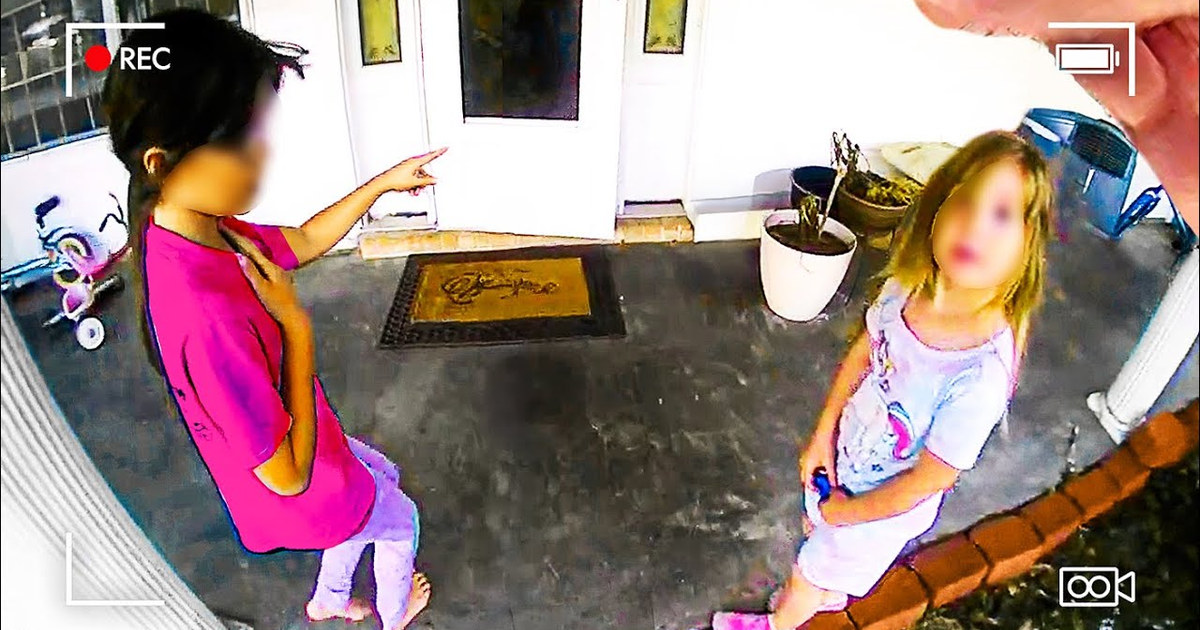
You have probably seen the chilling clip popping up across your feeds: small children guiding an officer through a quiet house while breakfast burns on the stove. It grabs you by the throat because it immediately forces an uncomfortable question onto the viewer. Can a killer truly script his own innocence in real time, or does calculated composure always give the game away?
The tragic footage out of DeRidder, Louisiana, documents the aftermath of the death of 28-year-old Ashley Fish. It plays less like chaotic raw footage and more like a grim psychological breakdown. We watch a narrative get engineered right before our eyes, exposing the terrifying gap between a staged alibi and cold reality.
In true crime docudramas like *The Jinx* (2015), the tension thrives on whether an offender's bizarre demeanor is pure shock or tactical planning. Here, the horrifying real-life footage wastes no time putting that exact dilemma to the test.
[[AD]]
The Anatomy of an Eerie 911 Call
The sequence begins on an April evening with a dispatcher receiving a call defined by an unnatural stillness. The caller simply states he needs to report a crime at a Northridge Drive address, then abruptly hangs up. When Officer Josh Stanford arrives, he is not met by the caller, but by four young girls left completely alone in the home.
The oldest daughter demonstrates unimaginable bravery, ushering her siblings away from the locked master bedroom toward safety at a neighbor's house. Inside the bathroom, police find Ashley Fish deceased from a single gunshot wound to the head, with unattended eggs still burning on the kitchen stove.
Much like the unsettling suburban dread captured in David Fincher's *Gone Girl* (2014), the domestic setting looks ordinary on the surface while masking absolute horror underneath. The caller had completely vanished, leaving behind confused children and a scene devoid of immediate answers.
[[AD]]
A Convenient Claim of Self-Defense
WARNING: Crucial details of the investigation and case evidence follow below.
The mystery breaks wide open when a second call comes into dispatch from a local parking lot. Thirty-four-year-old Tyler Durachowski announces he wants to turn himself in for shooting Ashley. He waits calmly by his truck, offering no resistance when police surround his vehicle.
Right away, Tyler floats his defense. He claims they argued over his impending move to Oregon, alleging Ashley retrieved her own Smith & Wesson handgun from a nightstand and pointed it at him before it accidentally discharged in a tussle. Investigators discover the weapon indeed belongs to Ashley, presenting a sudden evidentiary hurdle.
This sudden self-defense pivot mirrors the shifting perspectives explored in Errol Morris's *The Thin Blue Line* (1988). When the physical weapon supports the suspect's claim on paper, detectives must dig past surface facts to uncover the real dynamic behind closed doors.
[[AD]]
The Mask Slips Inside the Box
Detectives quickly spot cracks in the story. A search of Tyler's truck reveals syringes, prescription bottles, and vials of testosterone. More damning are the family statements and digital timelines. Just minutes before she was killed, Ashley texted her ex-husband Jon, pleading for help because Tyler refused to leave her home.
The lead detective, who personally grew up in the same town as Ashley, sits across from Tyler in the interrogation room. Tyler attempts to play the cooperative victim of circumstance, repeatedly insisting he never initiated violence and only wanted to protect the children from witnessing a fight.
[[VIDEO]]
The exchange carries the distinct psychological weight of *Mindhunter* (2017), where an interrogator lets a suspect speak freely until his own rehearsed logic caves under scrutiny. Tyler’s calculated calmness quickly starts reading less like genuine shock and more like an audition to escape a life sentence.
[[AD]]
When Rehearsed Innocence Fails
So, can a killer actually script his way out of a crime scene? The case of Ashley Fish proves that physical staging cannot survive the sheer weight of context, witness accounts, and the lingering digital footprint left behind by the victim.
Much like Truman Capote captured in *In Cold Blood* (1966), no matter how neatly an offender tries to compartmentalize violence, the raw humanity left in the wake always points back to the truth. Ashley's final desperate texts spoke far louder than any fabricated story.
This haunting footage reminds us of the quiet bravery shown by four young girls and the painstaking police work required to see past a suspect's carefully constructed mask. Stay tuned for our upcoming breakdown of the forensic evidence and courtroom aftermath in part two.


