Part 2
That is the seed. The bench is where Cheaters stages its loudest moments — the shouting, the handcuffs, the verdict delivered at volume. But not every betrayal is loud. Not every surveillance is a van with a telephoto lens. Sometimes the camera is a phone. Sometimes the evidence is a locked screen. Sometimes the bench is a bathroom, and the trinket is a text message, and the handcuffs are the quiet architecture of suspicion. Next, we turn to Gabby — whose husband changed his wardrobe, dyed his hair, and started spending a lot more time in the bathroom with his computer. Her story is not a bench scene. It is something more intimate, and in some ways more frightening: the surveillance you conduct yourself, on the person you love, from the other side of a locked phone.
Gabby's Locked Phone: The Quiet Architecture of Suspicion
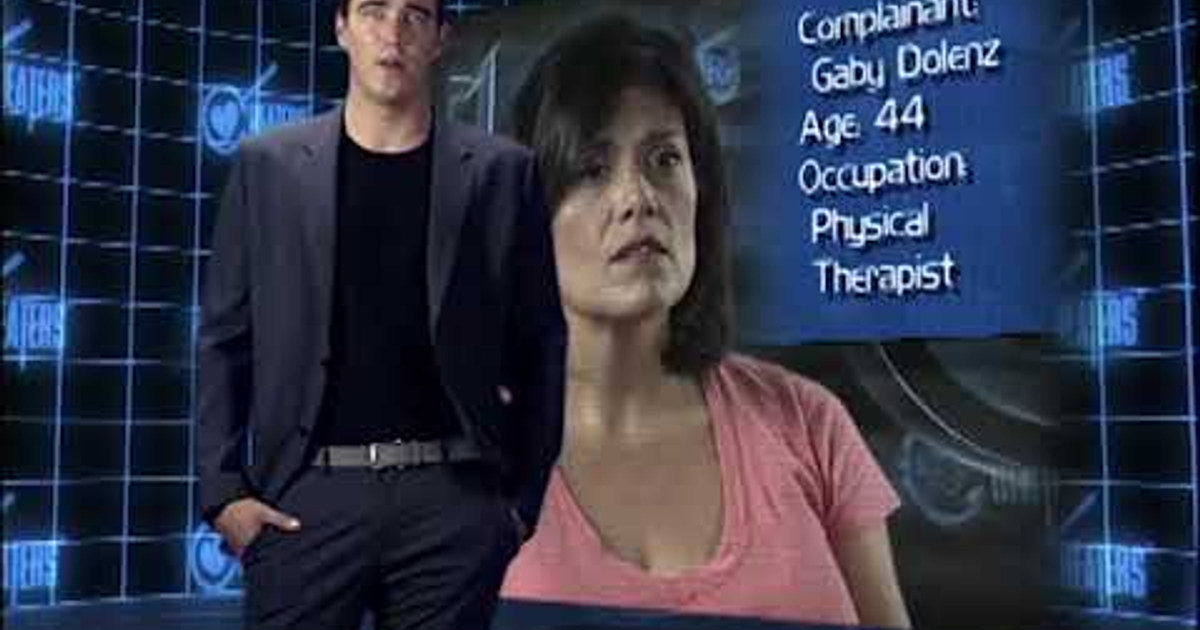
She remembers the flowers. That's the detail that stays with you. Not the shouting, not the cameras, not the bench — the flowers. "He was so attentive to me," Gabby Dollens says, her voice steady in that way people's voices get when they're holding something heavy. "He would bring me flowers for no reason. And when I was upset, he was a really good listener."
This is how betrayal begins on Cheaters — not with a scream in a parking lot, but with a woman remembering tenderness. Gabby is married to Richard, 39, a designer. Lately, Richard has changed his wardrobe. He's dyed his hair. He's working late, staying out, neglecting the family. And he's put a password on his phone.
That last detail is the one that matters. In the grammar of this show, a locked phone is a locked door. You don't need surveillance footage to know something is wrong. You just need to notice that the person who used to hand you their phone without thinking now guards it like a state secret.
Gabby's story is the domestic version of the bench. There are no cameras yet. No private investigators. Just a woman narrating her own unease, trying to make sense of the small changes that add up to something enormous.
The Password as Narrative Device
The password is not a plot point. It's a genre. In the language of screen storytelling, the locked phone is the modern confessional — and its lock is the modern betrayal. Think about how often this image appears in film and television: a character reaches for a phone that used to be open, and now it isn't. The gesture is small. The meaning is total.
In Catfish, the 2010 documentary by Ariel Schulman and Henry Joost, the entire drama hinges on digital reveals — text messages, Facebook profiles, the slow unraveling of an identity through screens. The phone is the site of truth. In Netflix's You, Joe Goldberg's obsession plays out through stolen glances at phones, through messages read over shoulders, through the constant threat of discovery. The phone is the site of danger. In Francis Ford Coppola's The Conversation (1974), Gene Hackman's Harry Caul spends the entire film listening to a recording, trying to decode a conversation that may or may not contain a betrayal. The surveillance is analogue, but the anxiety is the same. In Enemy of the State (1998), Tony Scott updates that paranoia for the digital age — Will Smith's character is tracked through his phone, his credit cards, his every move. The phone is the site of exposure.
Cheaters, for all its tabloid theatrics, understands this grammar instinctively. When Gabby says she used to be able to grab Richard's phone and see what was going on — "you're texting your brother or what's going on" — she's describing a world that has closed. The phone that was once a window is now a wall.
This is the quiet architecture of suspicion. It's built from small things: a password, a late night, a bathroom door that stays closed a little too long. Richard has been "in the bathroom on his computer a lot," Gabby says. That detail — the bathroom, the computer, the closed door — is almost comically mundane. It's also devastating. Because it tells you that whatever is happening, it's happening in the spaces where intimacy used to live.
The Investigation Begins
Cheaters Detective Agency assigns field agents. This is the show's machinery: the surveillance, the stakeouts, the cameras that turn private suspicion into public evidence. For Gabby, the waiting is over. The cameras are rolling.
Day three. Richard leaves work. He drives the family SUV — the family SUV — to an unknown apartment complex. There, he receives what the show calls a "warm welcome" from an unknown female. They go to a convenience store DVD kiosk. They spend time choosing a movie. Her choice wins. They return to her apartment for about two hours. Then Richard goes home to Gabby.
The DVD kiosk is a period detail that dates this episode to the mid-2000s, when Redbox and Blockbuster kiosks were ubiquitous. You could find them outside grocery stores, drugstores, fast-food restaurants. They were a small ritual of American domestic life: standing in front of a glowing screen, scrolling through titles, negotiating with your partner about what to watch. It was a shared decision. It was a small intimacy.
That's what makes it devastating.
[[AD]]
The DVD Kiosk as Domestic Ritual
Read the DVD-kiosk scene the way a novelist would. Two people stand in front of a kiosk. They browse. They debate. She picks the movie. He concedes. They walk back to her apartment together, carrying the evening's entertainment like a couple who has done this a hundred times before. Because they have. That's the point.


