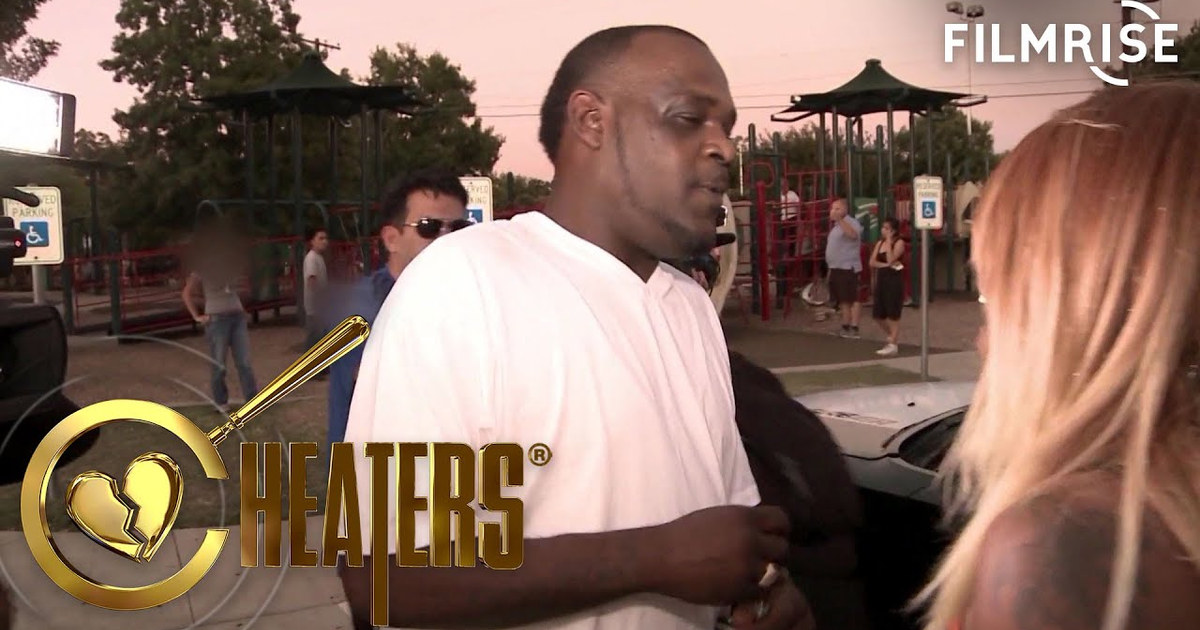
Part 1
Cheaters is the best-shot show on television, and the reason nobody says it out loud is that its cinematography isn't art — it's evidence, which is exactly why it works.
Quick credibility check, because it matters here: I've shot second unit for a long time. Second unit is the crew that grabs what the A-camera didn't — the inserts, the pickups, the long-lens stuff at the far end of the field while the leads do their thing under the softbox. Second unit is a discipline of patience. You sit. You wait. You get the shot that only exists because you didn't leave. That, more or less, is the entire production model of Cheaters.
Which brings us to Bar Alicia Malone's case. She hires the Cheaters Detective Agency because her boyfriend Chris, a 35-year-old electrician, keeps vanishing on her — and on her kids, who can't even get him to pick up the phone at night. Surveillance catches him meeting a woman named Brooklyn at a park, buying her ice cream, buying her clothes, and kissing her through the driver's window of his Charger. Then comes the bench. Everything below spoils that confrontation and the Elizabeth Green update at the end of the episode. Consider this your spoiler warning.
[[AD]]
The Long Lens Never Blinks: Chris, the Park, and a Charger Full of Bad Ideas
Watch the first surveillance beat and notice how little the camera actually does. Chris walks out of his apartment building. Cheaters operatives already have a perimeter up. He drives to a nearby park, gets out, and waits. A woman walks up, he walks her to his Charger, and the two leave together. Total elapsed screen time: maybe forty seconds. Total camera movement: almost none. That's the point.
Nothing in that sequence is staged for you. The frame stays wide, the subject stays small, and geography does the storytelling — the empty park, the parked car, the walk. This is what I'd shoot with a 150-600mm super-telephoto on a fluid head, parked a hundred yards out with the window cracked. And the reason it hits is compression. Long lenses flatten distance. They stack the woman, the man, and the car into a single plane so your eye reads them as one unit — a couple — before your brain has processed a single word of narration.
Then they follow the pair to a secluded part of the park, where the two enjoy one another's company in the most intimate of ways. Note what the show can't show and doesn't need to. The intimacy is implied through a windshield — the dirty frame is doing the censorship for them. A door, a headrest, a sliver of shoulder. The car becomes a matte box. You're watching through the only aperture available, and the limitation is the drama.
[[AD]]
Second surveillance day, same pattern — same park, same woman, now identified as Brooklyn, who grins hardly as she greets Chris with open arms. Same blocked-in shot, same lens. Consistency is a camera department's religion, and here it pays off: because the coverage looks identical to the day before, the audience instantly reads a pattern instead of a one-off. Repetition is a narrative device. This show accidentally built the most efficient one on television.
Then the ice cream. Then the vintage clothing store next door. Then the bag of clothes. Then the kiss through the driver's window — multiple times, described by our narrator as very, very romantic, which is a sentence that lands differently depending on which seat you're sitting in.
The Recording That Does the Work the Camera Can't
Here's where the technical picture gets interesting. The show drops in a recorded phone call — Brooklyn telling Chris to go do his thing and call her when he's done, signing off with "I love you." No image. Just audio. In film terms that's a sound bridge, and it does something the camera physically cannot: it proves intent. A long lens can show you a kiss. It can't show you the phone call that schedules the kiss. Reality TV's real advantage isn't its cameras, it's its paperwork — audio, phone records, receipts. The cinematography sets the table. The evidence pays for dinner.
[[AD]]
The Bench: Hard Sun, One Whip-Pan, and the End of a Two-Year Lie
And then the confrontation, which is shot like an entirely different show. Detective Gomez — the lead on the case, staged about two miles out — rolls up with Bar Alicia in the van and does a slow creep past the park. "Start going down lower to the right, right past this parking stop sign." That's blocking. That's a director and a driver working out a reveal in real time, and you can hear the whole thing happen on the mic.
The reveal lands on two white T-shirts on a bench, and the sun is directly overhead. Harsh noon, top-down, no fill, no diffusion, no bounce — the exact light a gaffer would burn down a set to avoid. Which is why it's perfect. Hard light does two things a softbox never can: it carves out cheekbones, and it blows the highlights on white cotton until the shirts glow like beacons. For about four seconds, the entire emotional payload of the episode rests on two blown-out white T-shirts, and the operator earns their paycheck.
Then Bar Alicia bails out of the van and it goes handheld, and not politely. Whip-pans. Crash zooms. A horizon tilting as the operator runs to keep up with a woman who is not walking. There's a moment where the audio clips and the framing cuts off a head, and a scripted show would have called that a ruined take. Here it's the best footage in the episode, because the camera is reacting, not observing. Chris apparently tries to bolt at one point, and the operator chases, because of course they do. The narrator's thesis is "you can't run from the truth." The camera's thesis is simpler: you can't outrun a handheld.


