Part 4
As we move on to the next chapter of Dolly's comedic legacy, we'll see how she turns self-deprecation into an art form. From trash to slime to pigeon statues, she proves that the best way to handle life's absurdities is to laugh at yourself. But first, let's savor the fearless humor that made us fall in love with her all over again.
[[AD]]
Trash, Slime, and Pigeon Statues: Dolly's Self-Deprecating Charm
There's a story Dolly Parton tells about a woman in her hometown — blond hair piled high, long red nails, bright red lipstick, high heels clicking down the street like a metronome. Little Dolly stared. Her mama pulled her close and said, "Don't look at her. She's just trash." And Dolly, wide-eyed, replied: "Mama, that's what I want to be when I grow up."
She's been chasing that woman ever since. Not the insult — the freedom inside it. The permission to be too much, to be loud, to be painted and piled and unapologetically ornamental. "I'm trash, y'all," she says now, decades later, still grinning. "I just want to look like trash." Then, quick as a wink: "I hope that I'm not trash." The audience laughs. She waits. She always waits for the laugh, then undercuts it with something softer. That's the trick of Dolly's self-deprecation. It isn't a wound. It's a wink.
And it started in a house with no money and a lot of kids. Her mother married at 14 and had 12 children. Dolly has joked that her mother got pregnant just from having the pill explained to her. That's the kind of line that lands because it's built on something real — a childhood where sex education was a rumor and dinner was whatever you could catch. Possum. Squirrel. Her father took one look at possum and declared it "nothing but a damn rat." Dolly tells it like a punchline. It is one. But it's also a window into a world where survival was a group project and humor was the only thing nobody could repossess.
That's the soil. The rhinestones came later. But the wit — the ability to turn poverty into a bit, to make an audience laugh at hunger without ever letting them pity her — that was forged early. Dolly doesn't ask for sympathy. She asks for a laugh, and she gets it, because she knows the difference between a joke that punches down and a joke that invites everyone into the room. She's never punching down. She's pulling up a chair.
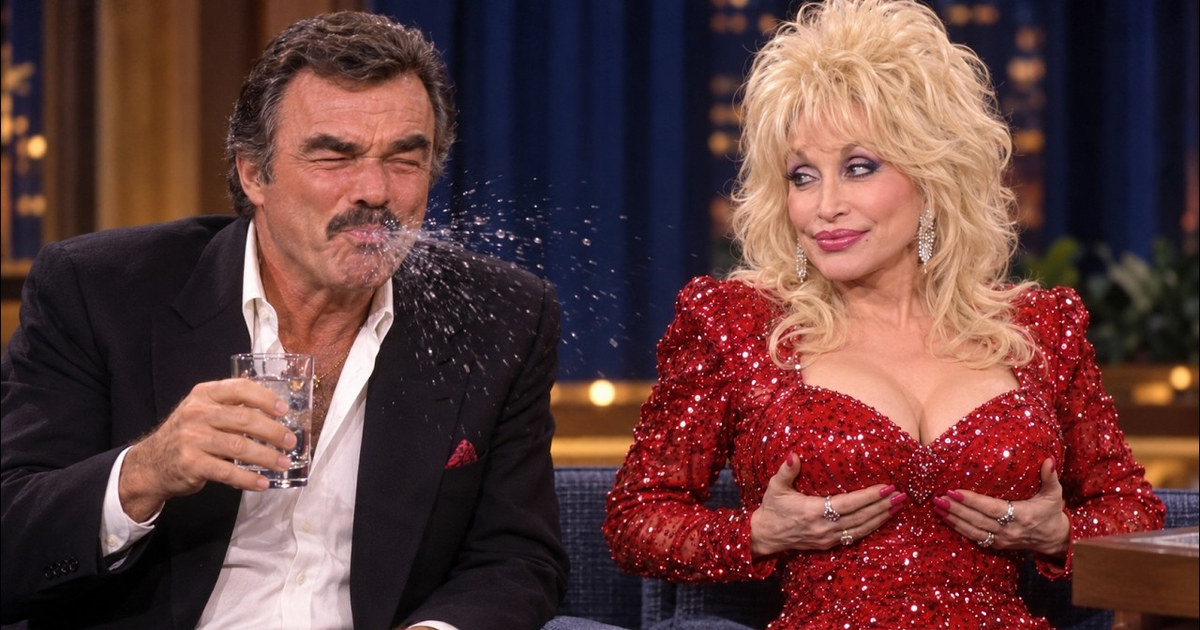
Which brings us to the pet peeve. For years, the press has been obsessed with her chest. Headlines, late-night monologues, tabloid speculation — it's all been about the boobs. Dolly's response? A deadpan sigh and the line that should be engraved on a plaque: "Nobody notices I've got a great ass, too." It's a perfect Dolly-ism. She takes the thing everyone's staring at and redirects the gaze — not defensively, but playfully. She's not offended. She's just correcting the record. And she's doing it with a smirk that says, "You're all missing the full picture, and that's your loss."
She's been managing that gaze since the beginning. In interviews, she's the one who brings up her own body before anyone else can, controlling the joke, setting the terms. When a host once dared her to take off her clothes during sweeps, she didn't flinch. She turned it into a bit about wardrobe malfunctions taking out the first three rows. When someone asked what Dolly Parton smells like, she leaned in and said, "Why don't you come over here and see?" The interviewer blushed. Dolly got a buzz off it. She always does.
But the self-deprecation isn't just about her figure. It's about her whole existence. She's called herself a drag queen who was born a girl. She's said if she hadn't been a girl, she'd have been a drag queen — "a really good one." That's not false modesty. That's a woman who understands that her look is a construction, a performance, a work of art. And she's the artist. She's not apologizing for the artifice. She's celebrating it.
Then there was the Nickelodeon slime. If you grew up in the '80s or '90s, you know the green goo. It was the network's signature gag — dumped on celebrities, kids, anyone game enough to stand under the bucket. Dolly stood under it. And when the slime hit, she didn't recoil. She laughed. She worked the crowd. She turned a messy, sticky moment into another chance to be in on the joke. Because that's the thing about Dolly: she never lets the joke be on her. She's always co-writing it.
That instinct — to take whatever's thrown at you and turn it into material — is the same instinct that built her songwriting. She's written thousands of songs, from "Jolene" to "9 to 5," from "I Will Always Love You" to "Here You Come Again." She's acted in films like 9 to 5 (1980, directed by Colin Higgins, 109 minutes), Steel Magnolias (1989, Herbert Ross, 117 minutes), and Straight Talk (1992, Barnet Kellman, 91 minutes). She's been on The Tonight Show, Late Night with David Letterman, The Oprah Winfrey Show, and every stage that matters. But the throughline is always the same: she's the one telling the story. She's the one holding the pen.


