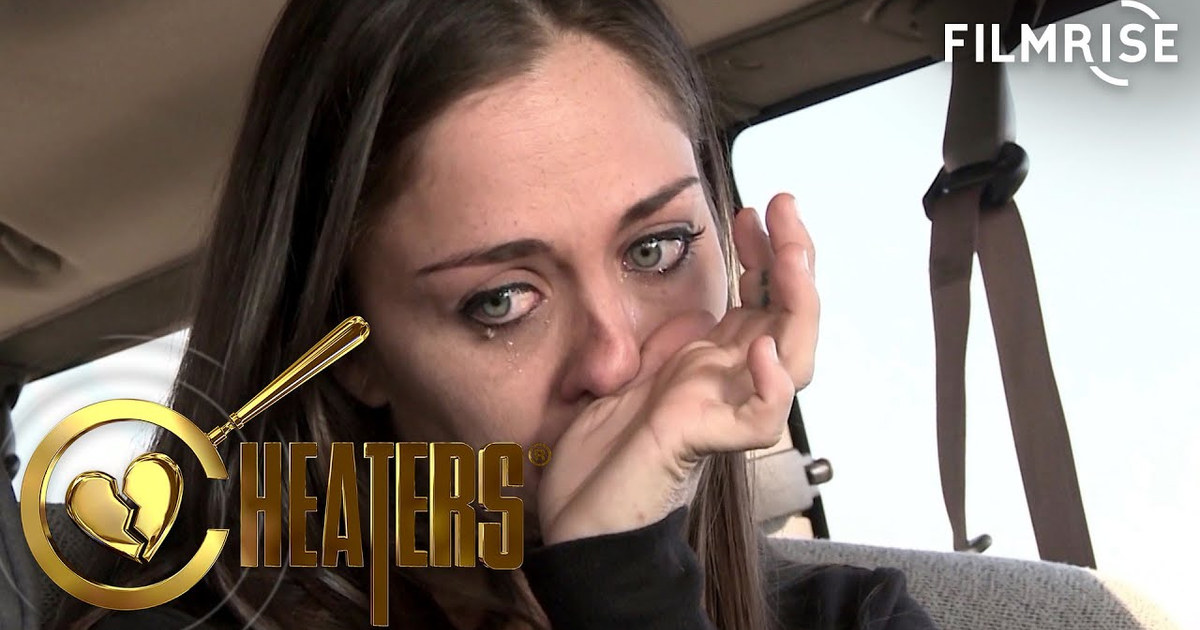
Part 1
First, look at this: a bright orange exercise shirt drenched in sweat, illuminated under the harsh fluorescent tubes of a suburban dance studio. Notice the way the collar hangs loosely, damp around the edges, entirely unsuited for the dramatic trial by television about to unfold. If you paused the broadcast right here, you might think you were looking at nothing more remarkable than a fatigued twenty-one-year-old catching his breath after sixty minutes of high-tempo Latin cardio. But take a half-step closer to the display case, because that vivid garment is the focal point of one of the most mechanically precise ambushes ever orchestrated in syndicated reality television history.
Welcome to our gallery walkthrough of an enduring artifact from the *Cheaters* vaults. This particular broadcast features host Clark Gable III, grandson of Hollywood royalty, presiding over the surveillance and subsequent roadside reckoning of Stephen, an errant bartender, and Kelly, the devoted massage therapist who dared to question why her partner routinely evaporated for eighteen hours at a stretch. Viewers often remember the fireworks, the shouting matches, and the flying accusations, but those loud moments only work because of the subtle, mundane choreography that precedes them.
Why do millions of us remain utterly transfixed by these low-resolution stakeouts decades after the format peaked? Is it merely the base thrill of voyeurism, or do these staged rituals satisfy an older, nearly classical dramatic impulse? As we move through this exhibit, leave your contempt at the door. Let us examine the piece not merely as trash television, but as an intricately constructed urban morality play, complete with its own fixed chorus, mobile field operatives, and unbending aesthetic rules.
[[AD]]
Stop One: The Bartender's Clock and the Anatomy of Suspicion
Our tour begins in the temporal limbo of early morning shifts and service-industry habits. Kelly Torres stands before the camera explaining the disruption that began her descent into institutional paranoia. Stephen works behind a bar, an occupation with elastic hours that naturally cloaks irregular movements. He customarily worked out around eight or nine in the morning, an established domestic rhythm that offered structure to their life together. Then came the rupture: a night after work where he went dark entirely, vanishing from contact until three o'clock the following afternoon.
Consider the psychological weight Kelly assigns to those silent hours. In the modern romantic contract, the pocket computer serves as a continuous tether; to be silent across twelve to eighteen hours is not simply an absence of conversation, but an active declaration of absence. Kelly speaks not with instant rage, but with the weary anxiety of a caregiver wondering whether her partner ended up in a ditch. Notice how she articulates the threshold: she had brought him to meet her family, an honor she had never accorded any previous partner. In her ledger, emotional investment had been formally signed and notarized.
Yet, even here, notice the narrative friction. Stephen is twenty-one years old. Kelly speaks of serious long-term horizons, while Stephen is operating on the developmental timeline of someone whose primary concerns are tips, sleep schedules, and casual autonomy. As the docent behind the glass, Clark Gable III establishes the tone with an arch, faux-Victorian sobriety, labeling Stephen as a man mixing 'unwelcome adulterants' into his domestic cocktail. The language is grand, deliberately out of scale with the cheap apartments and parking strips on screen.
[[AD]]
Stop Two: The Cheap Date Taxonomy and the Auto Parts Stakeout
Step into the middle gallery to view the investigative archive itself. The surveillance team picks up Stephen outside his residence and trails him into the wild. Where does our youthful antagonist take his newly acquired paramour? Not to an opulent, hidden hideaway, but to an unvarnished family buffet: Cici's Pizza. Observe the camera lens peering between headrests and windshield wipers. We see Stephen with his arm draped possessively over the mystery woman, sharing inexpensive slices under commercial strip lighting before lingering in the asphalt expanse outside for an unhurried make-out session.
Notice the recurring staging ground throughout this tape: the QuikTrip convenience store. Stephen does not choose scenic promenades or high-end bistros; his rendezvous are tethered entirely to roadside infrastructure. He and this companion, later identified as Carrie, orchestrate what can only be described as a caravan through the modern metropolis. They travel to an athletic stadium to take snapshots against stone steps, a pantomime of touristic romance executed entirely within driving distance of their daily haunts.
Now look closely at the auto parts store sequence, arguably the most telling behavioral snapshot in the entire dossier. Stephen pauses at a retailer, emerges with a bottle of engine coolant, and hovers over Carrie’s open hood, dutifully topping off her car's vital fluids. Here is the paradox of infidelity laid bare for the viewing audience: the suspect withholds basic domestic courtesy from the woman waiting at home, yet eagerly performs the protective ritual of the amateur mechanic for his clandestine partner. As Gable would later remind Kelly during the presentation of evidence, when was the last time he held a car door for her?
During that exact moment by the open hood, Stephen’s phone rings. The audio intercepted by the production unit captures Kelly on the line, reaching out while Stephen casually delivers reassurance with grease on his fingers and Carrie standing inches away. It is a masterpiece of situational irony, the kind of documentary contrast that television editors spend years learning to orchestrate.


