Part 2
Stop Three: The Slalom Skirmish and Carson as the Straight Man
Our third stop brings us to an apparent detour: winter sports. After trading confessions about snooping—Carson famously admitting he inspects medicine cabinets at parties, while Hackett claims he wanders into strangers' open front doors—the conversation turns to the bruised forehead of the sitting President of the United States. Jimmy Carter had suffered a cross-country skiing spill, providing Hackett with raw material.
[[AD]]
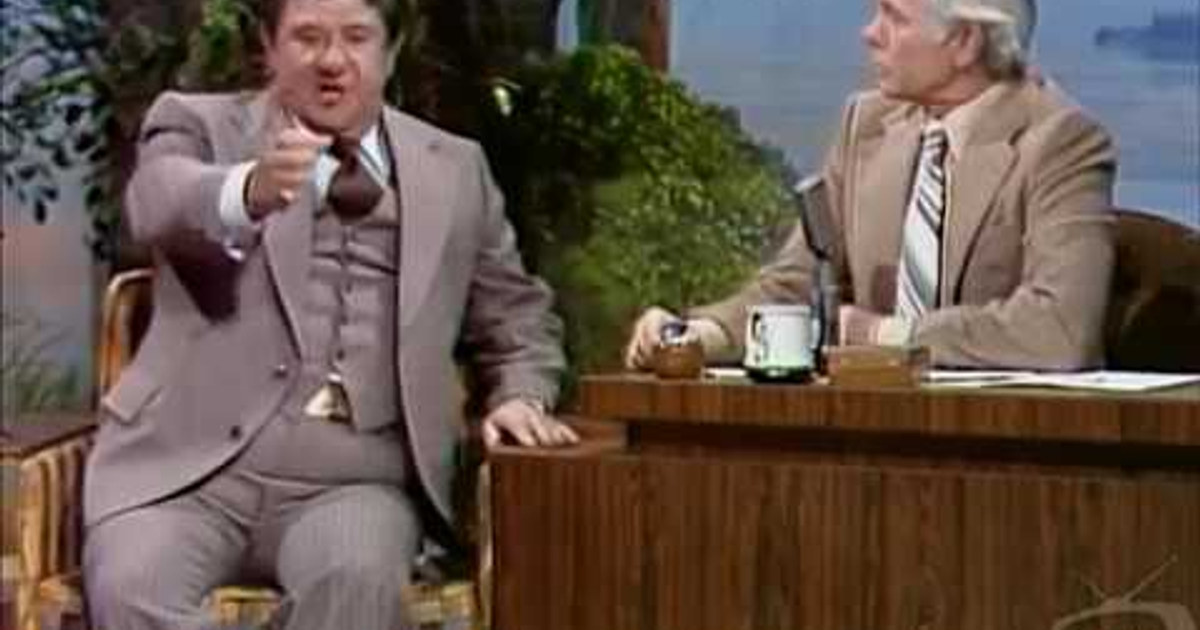
Hackett dismisses cross-country skiing as backbreaking manual labor and declares himself strictly a downhill skier. Carson steps directly into a trap by asking the seemingly innocent question: 'Isn't downhill skiing redundant? You never hear of an uphill skier.' Watch how Hackett pivots on a dime to turn Carson's technical semantics into a mock trial of intellectual arrogance.
Hackett immediately blows up the premise: 'What is he swinging that at me now? You got me for stupid too, right? A funny-looking fat guy who can't ski uphill and who's stupid? My mother right now is glad she's dead!' The studio audience roars not because of the absurdity of skiing uphill, but because Hackett expertly reframes Carson's light intellectual poke as an existential assault on his dignity.
Carson tries to dig his way out by defining slalom—weaving through gates on a marked course—versus open downhill racing. Hackett refuses to let Johnny regain high ground. He brings the setting back to his home turf: Lee Canyon, a humble, single-lift hill outside Las Vegas where amateur gamblers and tourists attempt to ski with zero instruction. Hackett paints a vivid, frantic portrait of people who do not know how to stop, using Buddy's stout, padded frame as a literal human barricade, leaving him covered head-to-toe in ski wax.
Notice what Hackett has done here. In five minutes, he has transformed himself from a Hollywood celebrity vacationing in Idaho to an exhausted, wax-smeared safety cushion on a dusty Nevada mountain. He continually subverts any hint of glamour, dragging Johnny down into the gritty mechanics of everyday absurdity.
[[AD]]
Stop Four: Apex Predators, Billy Carter, and the Court of Public Opinion
Now, observe how effortlessly Hackett navigates cultural danger zones that would terrify modern media figures. He drops a passing reference to an acquaintance named Lewis Dorman, an eccentric figure who supposedly lives with wild cats. When Hackett previously mentioned Dorman on The Tonight Show, the man owned a mountain lion; now, Hackett reports, Dorman has acquired a three-hundred-pound panther that requires no feeding because burglars provide all the necessary protein.
Without skipping a beat, Hackett uses the panther story to slingshot into national headlines: Billy Carter's controversial, beer-fueled public comments regarding Jewish people. In the late 1970s, this was a blistering front-page controversy. How does Hackett handle it? By stepping directly onto the third rail with absolute, audacious glee.
'I can't help but make a comment about Billy Carter,' Hackett declares. 'I read the paper and I see what he said about Jews and all. You know, I'm a Jew. I'm a big Jew. Very important Jew.' Carson looks delighted and slightly terrified as Buddy leans into the microphone, boasting about his supposed VIP status in the global Jewish community before granting Billy Carter an unexpected pass of comedic empathy.
Hackett points out that when a working man drinks a few beers and reporters continually bait him with provocative questions, you can steamroll him into saying anything regrettable. Hackett connects it directly to his own life: 'You have said things have you not at times that you wish you hadn't? My lawyer wishes I didn't say. I get in a lot of trouble.' It is a breathtaking display of high-wire empathy, defusing a national political scandal with streetwise tavern wisdom.
[[AD]]
Stop Five: The 2:00 AM Departure to Seattle
We arrive at the final, crowning movement of Hackett's performance: the breakdown of his twenty-four-year marriage to his wife, Sherry. In modern television, domestic routines are often smoothed down into saccharine homilies. In Hackett's world, marriage is an endurance sport fought under the rules of psychological siege warfare.
Carson brings up the groundbreaking Lee Marvin palimony case, wondering about long-term domestic arrangements. Hackett proudly notes that in nearly a quarter-century of marriage, divorce was never once mentioned—'Murder every day, but never divorce.' He then outlines his preventative morning strategy: waking up, turning to his wife, and immediately saying, 'I'm sorry,' thereby buying blanket immunity for whatever unknown infractions might unfold over the next twenty-four hours.
Then comes the Seattle epic. Hackett describes a late-night argument so intense that Sherry declares she is walking out. Hackett, too weary to engage in the customary ritual of pleading and wailing, calls her bluff and tells her to go ahead. Offended that he broke the script, she snaps back, 'This is my house, you go!' Buddy doesn't hesitate. He retreats to his dressing room, packs a single black suit, two white shirts, a tie, toothpaste, and his gout medication—the emergency kit of a seasoned Borscht Belt comic prepared to play a sudden weekend booking in the Catskills.
He walks out into the garden atrium under the moonlight, suitcase in hand. Sherry leans over the second-story balcony and demands to know where he thinks he is going. Hackett looks up into the night air and shouts the first geographic location that pops into his head: 'Seattle!' Instantly, the domestic stalemate breaks. Sherry orders him back upstairs, and Hackett promptly obeys.


