Part 1
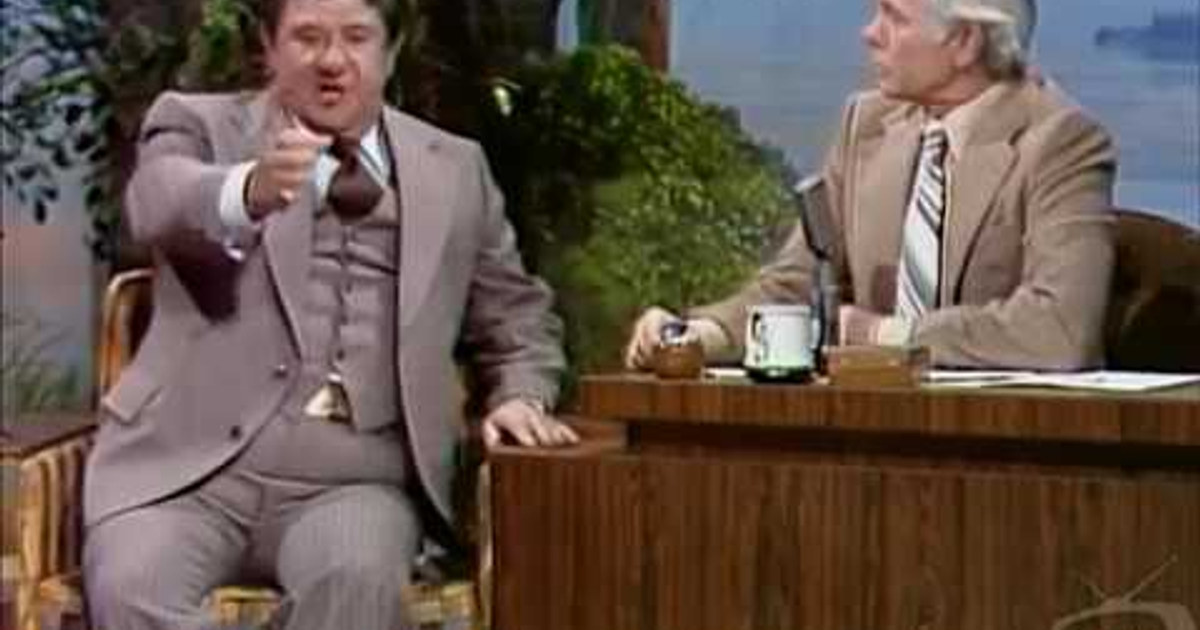
First, look at this: watch Buddy Hackett's lower jaw the exact second he settles into the leather guest chair across from Johnny Carson. Most guests on late-night television spend their first ninety seconds adjusting their jacket, flashing a rehearsed grin at the monitor, or glancing nervously at the studio audience to gauge their reception. Hackett does none of that. He drops his chin, pushes out his underbite just a fraction of an inch, and lets his eyes narrow into a sleepy, calculating slit. He is not preparing to be interviewed; he is setting an ambush.
We are looking at an artifact from the golden era of The Tonight Show Starring Johnny Carson, an episode where the guest list boasts heavyweight royalty like Sally Field, Tony Delia, and ragtime legend Eubie Blake. Yet from the second Hackett clears the curtain, the entire hour bends irreversibly around his gravitational pull. Why does this specific couch visit endure in the minds of comedy historians while thousands of other late-night segments evaporate into cultural static?
Because what looks like a breezy, off-the-cuff late-night chat is actually an masterclass in comedic tension, tactical vulnerability, and storytelling architecture. Step past the velvet ropes of the archive, take a breath, and let us walk through this performance piece by piece, in an order that reveals how the machinery actually turns.
[[AD]]
Stop One: The Cary Grant Illusion and the Geometry of Self-Deprecation
Notice how the segment begins not with a plug, a project, or a polite greeting, but with an argument over facial structure. Carson makes the classic mistake of trying to pay Hackett an affectionate compliment: he insists that Buddy looks like a comedian should look, possessing an amusing, expressive face. Watch how instantly Hackett weaponizes the compliment, transforming Carson's polite observation into a class-action indictment of mid-century aesthetics.
Hackett immediately counters by labeling himself a 'homely son of a gun' and a 'funny looking dummy,' contrasting his own visage with Carson and Ed McMahon. He calls them 'handsome, waspish-looking guys' and crowns Carson 'Mr. Mayonnaise.' Why does Hackett do this so aggressively in the first two minutes? Because he understands the physics of stand-up: whoever controls the definition of the clown controls the room.
By juxtaposing himself against Johnny's pristine, midwestern, network-anchor jawline, Hackett establishes the exact emotional stakes of the encounter. Carson becomes the patrician gatekeeper, and Buddy becomes the chaotic outsider who somehow snuck into the country club. When Hackett quips that Cary Grant always secretly wanted to look like him while he would happily take Grant's looks the moment Cary was finished with them, the studio audience explodes because the logic is airtight. It is pure Borscht Belt subversion dressed up as Hollywood self-effacement.
[[AD]]
Observe Carson's posture during this opening exchange. Johnny knows when to lead and when to become the world's most expensive audience member. He leans his elbows on the desk, tilts his head, and lets Hackett run the board. Carson understands that Buddy's rhythm relies on pushing the host until Johnny has to defend his own compliments—a dynamic that immediately erases the safe, scripted boundaries of promotional television.
Stop Two: The Sun Valley Heist and the Suspicion of High Society
Now, let us bypass the usual chronology and jump straight into the middle of Hackett's first extended narrative: the Averell Harriman cottage in Sun Valley, Idaho. Notice how seamlessly Hackett bridges the conversation from being called 'Mr. Mayonnaise' to a vacation story involving American political royalty, the Kennedys. The transition seems accidental, but it is surgically precise.
Hackett sets the scene with meticulous environmental detail. The resort staff treated him like royalty because they did not yet understand his 'behavior pattern.' They housed him in the prestigious Harriman Cottage, immediately following an occupancy by the Kennedy family. In the cottage was a single locked closet reserved for permanent owners—a detail Johnny instantly recognizes from his own stays at the Sahara house in Las Vegas.
What does a comedian do when confronted with a locked door belonging to the American aristocracy? Hackett does not admire the mystery from afar; he breaks in with Sahara stage manager Walt Jagodinsky and a friend named Sandy. Inside, they discover a modest, polite handwritten note from one Kennedy sister-in-law to Ethel Kennedy, leaving behind a humble tin of cocoa, a can of soup, and a few minor household remnants.
[[AD]]
Here is where the architecture of the joke reaches stratospheric heights. Hackett decides that a Kennedy leaving another Kennedy a lone can of cocoa is 'embarrassing.' His solution is not to steal the provisions, but to wage an aggressive war of culinary surplus. He purchases twenty-four bottles of mayonnaise, jars of peanut butter, stacks of white bread, and extra canned goods, jamming the closet to the brim.
Then comes the crescendo, the detail that transforms an amusing prank into theatrical folklore: Hackett hangs a raw carp inside the closet. 'A real Gentile carp,' as he deadpans to Johnny. Because the Kennedys were not scheduled to return for another two weeks, the punchline hangs in the air long after Hackett vacates the premises, turning an elite mountain retreat into an impending sensory disaster.
Look closely at Carson's face while Hackett explains hanging the carp. Johnny covers his mouth with a pencil, his shoulders hitching in silent laughter before he finally loses composure. This is not the laughter of a host keeping a segment moving; it is the helpless, gasping reaction of a man picturing an aristocratic family unlocking a closet in Idaho to be greeted by rotting river fish and two dozen jars of Kraft.


