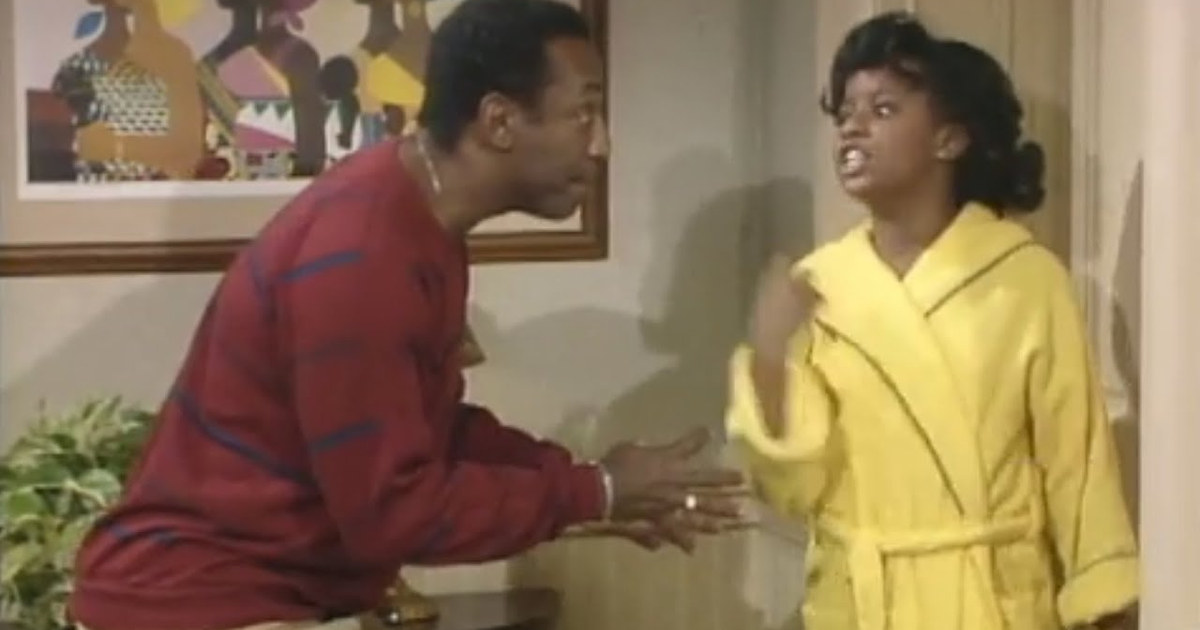
Classic multi-camera sitcom visual storytelling succeeds or fails based entirely on how dynamic blocking and practical key-lighting transform standard three-walled sets into living, breathing pressure cookers.
When you look back at prime-time television history, it is easy for critics to attribute a hit scene's success strictly to sharp dialogue or charismatic lead acting. But as someone who spent years on second-unit crews lining up camera axes and balancing visual planes, I look at classic scenes through the glass of a 35mm prime lens. The craft lives in how physical spaces are utilized.
In this classic sequence where Dr. Cliff Huxtable scrambles to get four kids out the door while rehearsing his Physician of the Year acceptance speech, the humor isn't just in the script—it is built into the physical choreography, depth of field, and precision lighting grids above the soundstage.
[[AD]]
Scene Beat 1: The Master Bedroom Speech under Soft Tungsten Key
The sequence opens on a wide master framing in the primary bedroom set, establishing an immediate ticking clock as Cliff rehearses his acceptance speech while Claire maneuvers between clothing racks and vanities.
From an operator's perspective, the lighting grid is rigged to maintain a rich, warm tungsten glow that creates a clean 3:1 contrast ratio across the bedroom set walls, ensuring the characters stay distinctly separated from the background visual plane. Using mid-range focal lengths—likely locked around a Cooke 35mm or 50mm glass equivalent for multi-cam tape setups—the DP keeps both actors sharp without causing wide-angle distortion on their facial features.
When Cliff delivers his joke about winning the award by a single vote, his physical shift toward Claire forces a natural frame re-balance. Instead of cutting away to a quick close-up punch, the camera operator relies on the actors' physical movement to reframe the shot naturally, keeping the scene's momentum alive inside a shared depth of field.
[[AD]]
Scene Beat 2: Hallway Standoff and Doorframe Spatial Depth
The action spills out into the narrow hallway corridor during the stolen hairbrush dispute, and the visual structure immediately pivots to use structural doorjambs as natural framing elements.
As Cliff confronts Rudy leaning against the bedroom door, the camera operator captures a brilliant multi-plane composition. The door frame literally bisects the focal area, creating instant depth between the active hallway and the off-screen bathroom chaos.
Notice how the overhead edge lighting catches the top of the door trim and highlights the actors' profiles as Cliff orders Rudy to step two paces to the side. By enforcing strict physical movements across the floor plane, the blocking controls the comedic timing as rigorously as a whip-pan cut, compressing three characters into a tight visual choke point.
[[AD]]
Scene Beat 3: Theo’s Mirror Light and the Bathroom Bottleneck
The spatial tension hits its high point when Theo pushes into the hallway frame, complaining about competing with four women for mirror space while trying to prepare his face for the evening.
When Cliff tells Theo to step down into the light, it functions as both a perfect line of dialogue and a real-time technical directive that positions the actor squarely into the practical key-light beam.
By forcing Theo down into that specific lighting zone, the crew ensures his facial expressions catch the eye-light bounce cards off-camera without forcing a reset of the camera pedestal heights.
[[VIDEO]]
This seamless integration of actor movement and fixed lighting bounds is what separates average sitcom setups from masterclasses in multi-camera visual rhythm.
What to Watch For on Your Next Rewatch
Spoiler warning: If you haven't revisited this classic visual sequence lately, prepare yourself for an absolute masterclass in spatial control.
On your next rewatch, try looking past the punchlines for a moment. Pay attention to how the camera pedestals hold their marks, how hallway doorways create dynamic layer depth, and how the actors land precisely in key-light pools to maximize every beat. Stay tuned to ReelDrop for our next camera-deck breakdown!


