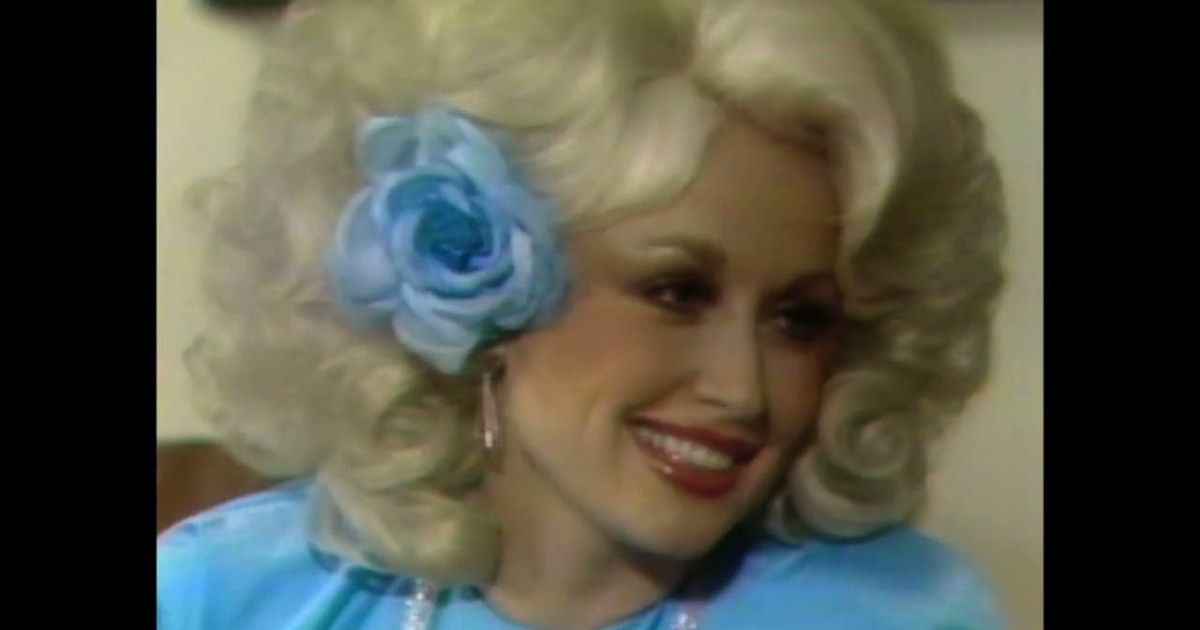
Part 2
Now look at the numbers. Walters asks what she made as a country star. Dolly says $500,000 to $600,000 a year — before expenses, not counting records. That's 1977 dollars. That's real money. But she doesn't stop there. She says, 'I've been working too hard, too long, for too little.' And then she lays out the plan: she wants to be a 'superstar' because 'in order to be a superstar, you can't be just a superstar in one area.' That's not a joke. That's a growth strategy. She's not saying, 'Look at me, I'm silly.' She's saying, 'Look at the math. I'm underpaid and I'm fixing it.'
And she was fixing it. By the time Walters sat down with her, Dolly had already left The Porter Wagoner Show — the split that gave us 'Goodbye Porter Wagoner' and the Hollywood agent and the family band. Walters brings it up, probably expecting defensiveness. Dolly doesn't flinch. She says, 'I'm not making a crossover from country to pop. I'm trying to be accepted in the pop field as well as the country feeling.' Read that carefully. She's not abandoning country. She's expanding. She's not turning her back on the Grand Ole Opry. She's building a second door. That's a business decision, not a punchline.
The consensus loves to treat Dolly's image as armor — the wigs, the curves, the rhinestones — as if she put them on to hide. But armor is defensive. Dolly's image was offensive. It got her on the poster. By 1980, she's in 9 to 5 with Jane Fonda and Lily Tomlin, directed by Colin Higgins. That movie made over $100 million on a $10 million budget. By 1982, she's in The Best Little Whorehouse in Texas, directed by Colin Higgins again, alongside Burt Reynolds. By 1985, she's in Rhinestone with Sylvester Stallone. She's not a joke in those films. She's a box office draw. The wigs and the curves got her the meeting. The talent kept her in the room.
[[AD]]
Compare her to other stars who used image as armor. Mae West, Liberace, Elton John. The consensus treats Dolly like Liberace — a camp icon who was in on the gag. But Liberace never said, 'I would never stoop so low as to be fashionable.' Liberace wanted to be fabulous. Dolly wanted to be a superstar. Different goals. Liberace's image was the destination. Dolly's image was the vehicle. She said it herself: 'Once they got past the shock of the ridiculous way I looked and all that, then they would see there was parts of me to be appreciated.' That's not a joke. That's a funnel. The image got attention. The attention got her the platform. The platform got her the money and the power to do what she wanted.
And what did she want? Not just fame. Freedom. She tells Walters, 'I need freedom.' She says it about her marriage, but it applies to her career too. The whole point of being a superstar was to stop being dependent on one industry, one audience, one man. The Porter Wagoner split wasn't personal. It was structural. She was building a career that couldn't be controlled by anyone else. That's not a joke. That's independence.
So when the consensus says Dolly's image was a joke she was in on, I say: you're half right. She was in on it. But it wasn't a joke. It was a machine. And she was the one running it.
Dismantling the Consensus, Part 2: The 'Joke' Reading Misreads Her Class Politics
[[VIDEO]]
The consensus says Dolly Parton's image was a joke about her hillbilly roots. She dressed like a cartoon version of a poor Tennessee girl — the wigs, the makeup, the tight clothes — as a way of laughing at where she came from. The consensus says she turned her poverty into a punchline. It's a tidy theory. It's also wrong.
She didn't turn her poverty into a punchline. She turned it into armor. And the difference matters.
Go back to that Barbara Walters interview. Walters asks, point blank: 'Where I come from, would I have called you a hillbilly?' This is the moment the consensus points to as proof of the joke. But listen to what Dolly actually says. 'If you had have, it would have been something very natural, but I would have probably kicked your shins or something.'
Kicked your shins. That's not a laugh line. That's a threat. A playful one, sure, but a threat. She doesn't giggle and wave it off. She pushes back. Then she goes further: 'We were very proud people, people with a lot of class. It was country class, but it was a great deal of class.'
That's not a joke. That's a defense of her people. She's not mocking the 'Li'l Abner people, Daisy May and that sort of thing.' She's saying those stereotypes were taken from people like her — and those people had class. 'Most of my people were not that educated, but they are very, very intelligent. Good common sense, horse sense we called it.' She's not laughing at them. She's honoring them.
The consensus hears the wig and the accent and assumes she's in on the mockery. But she's not mocking. She's correcting the record. There's a difference between laughing at where you came from and refusing to let anyone else laugh at it. Dolly did the second thing.


