Part 1
An elderly woman named Jean sits upright on a sofa, the afternoon light thinning across the living room carpet, her hand lifted toward an empty armchair across the room. Her daughter, Julie, freezes, braced for the clinical heartbreak every child fears—the moment dementia or metabolic confusion finally fractures the maternal mind. Jean does not blink or waver. She points at the empty velvet cushion and speaks in the flat, grounded cadence of someone noting the weather: her own mother, dead thirty years, is sitting right there, quiet, patient, waiting to walk her home.
The sentence hangs in the apartment like a flare fired into a darkened theater. There is no tremor in Jean's voice, no manic agitation, no delirium. When her daughter resists the urge to correct the optic reality in front of them, what enters the room isn't madness, but an uncanny, stabilizing stillness. For Dr. Christopher Kerr, a neurobiologist and the Chief Medical Officer at Hospice and Palliative Care Buffalo, this moment is not an anomaly to be medicated away. It is the signature scene of a universal human drama that modern clinical medicine has spent decades trying to ignore.
Kerr's landmark research—spanning more than 1,500 meticulously documented interviews with terminally ill patients—repositions our understanding of the threshold between life and death. Armed with video cameras and standardized psychological assessments, Kerr pulled dying out of the sterile margins of organ failure and placed it back into the narrative traditions of literature and cinema. What he discovered dismantles the cynical assumption that the dying brain merely short-circuits. Instead, the final act of consciousness behaves like an exquisite master editor, assembling an ensemble cast of precisely those figures who anchored the soul in life.
[[AD]]
The Rejection of Metaphor: Why Deathbed Visions Defy Classical Dream Logic
In literature, dreams are famously heavy-handed, overloaded with Freud's neurotic debris and surrealist riddles. We expect tornadoes to symbolize crisis, teeth falling out to signify vulnerability, or winding corridors to mirror the labyrinth of guilt. But Kerr's data reveals that end-of-life experiences (ELEs) strip away the baroque machinery of classical dreaming entirely. When dying patients close their eyes—or drift into the waking reveries that account for half of these recorded events—they do not encounter monsters, abstract puzzles, or allegories.
They see people. Real people, rendered with astonishing optical acuity. Patients consistently rate the realism of these encounters at a maximum ten out of ten. If a ninety-five-year-old woman lost her mother at age five, she does not see a misty archetype draped in biblical light; she smells the specific lavender oil on her mother's collar and hears the acoustic timbre of her voice echoing across ninety years of silence. The encounter possesses none of the fragmented absurdity of REM sleep.
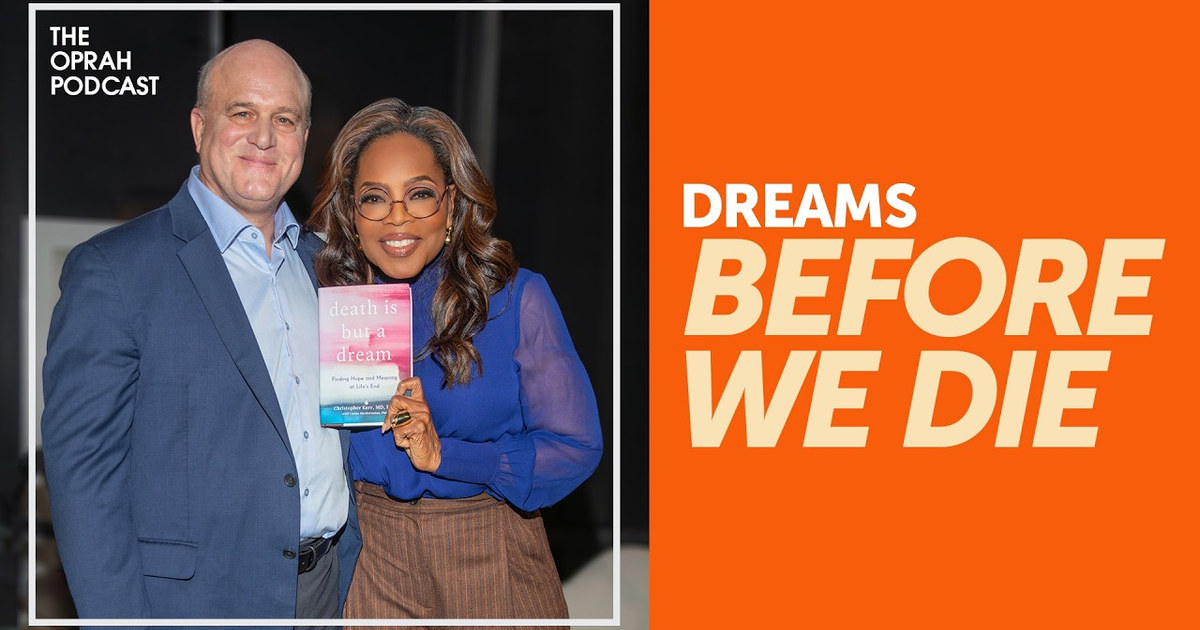
Crucially, as Kerr noted in his long conversation with Oprah Winfrey, across nearly three decades of palliative care, not a single patient has ever turned to him and asked, 'What do you think this means?' In standard psychology, the dreamer is haunted by ambiguity, desperate for an analyst to translate the psychic hieroglyphs. At the edge of mortality, meaning does not need a translator. The scene is delivered whole, transparent, and instantly integrated into the emotional marrow of the person departing.
[[AD]]
The Palliative Camera: Capturing the Unrehearsed Lucidity of Dying
The decision to bring high-definition cameras directly to the hospice bedside was born out of profound institutional frustration. In the rigid hierarchy of tertiary hospitals, physicians are trained to view dying exclusively as a sequence of failing metrics: plummeting glomerular filtration rates, dropping oxygen saturation, decaying heart rates. When nurses reported that patients were conversing with long-dead relatives, doctors wrote off the phenomenon as toxic encephalopathy, drug-induced hallucinations, or hypoxia.
By rolling cameras, Kerr established an irrefutable evidentiary archive. The footage does not show slurring, agitated subjects lost in the fog of heavy opioids. It reveals lucid, composed human beings speaking with razor-sharp insight. The subjects describe these visitations not as nightmares or delusions, but as happenings—sovereign events that arrive to settle old scores and soothe lingering anxieties. Far from clouding their cognition, the visions appear to sharpen their understanding of where they stand on the map of their own lives.
This documentary approach mirrors the observational realism of directors like Frederick Wiseman or the compassionate intimacy of Chantal Akerman. The camera acts not as an intrusive medical probe, but as an impartial mirror. In watching these tapes, young physicians are forced to confront the limits of their pharmacological hubris. You cannot medicate someone out of an encounter that is actively healing them.
[[AD]]
A Final Moral Justice: The Selective Casting of the Subconscious
One of the most striking patterns Kerr uncovered is what can only be described as a form of final poetic justice. The dying subconscious is brutally discerning. The people who show up at the bedside are rarely the ones who held worldly power or demanded loyalty through fear; they are overwhelmingly the figures who offered unconditional nurture and emotional security.
If a parent was emotionally withholding or abusive, they are quietly edited out of the script. If a patient was married three times across an eventful life, the psyche does not assemble a chaotic committee; the second spouse, the one who genuinely loved and sheltered them, appears alone at the edge of the bed. Kerr points out that family members who failed the foundational test of love are simply excluded, while a single sibling or a quiet guardian who offered safe harbor takes center stage.


