Part 1
Every television show has a hidden architecture, a set of structural beams and load-bearing pillars that keep the entertainment from collapsing into white noise. For the casual viewer, a show like the BBC's long-running panel game *Would I Lie to You?* is a delightful exercise in social deduction, a cozy parlor game played by exceptionally witty people. This is the viewer who comes for the genre: they want the narrative tension of the mystery, the satisfaction of the reveal, and the comfortable rhythm of the banter. They want to know if the story is true, and they want to laugh along the way.
But there is another kind of viewer—the one who approaches television the way a hobbyist programmer approaches a piece of legacy code. This viewer is obsessed with the craft. They do not just want to know if the story is true; they want to map the execution stack of the joke. They want to analyze how a comedian allocates cognitive memory to construct an improvisation in real-time, how a narrative engine handles unexpected exceptions, and how physical geometry is translated into verbal syntax. To this viewer, a five-minute segment of *Would I Lie to You?* is not just a game; it is a beautifully optimized state machine.
In this deep dive, we are going to look at one of the most structurally elegant segments in the show's history: the "This is My" round featuring a mystery guest named Jake. By examining this segment through both lenses—the narrative satisfaction of the genre fan and the mechanical precision of the craft enthusiast—we can begin to understand how British panel comedy operates at its absolute peak. We will see how three distinct comedic styles attempt to solve the same engineering problem: how to make an absurd premise feel structurally sound.
[[AD]]
The Setup: A Three-Way Multiplexer of Comedy
The "This is My" round is a classic piece of television design. It functions as a three-way multiplexer: three distinct inputs (the panelists) claim a connection to a single output (the mystery guest, Jake). Only one of these connections is active; the other two are dummy lines designed to mimic the signal of truth. The opposing team, led by the hyper-logical David Mitchell, must parse the data packets, run sanity checks, and determine which connection is genuine.
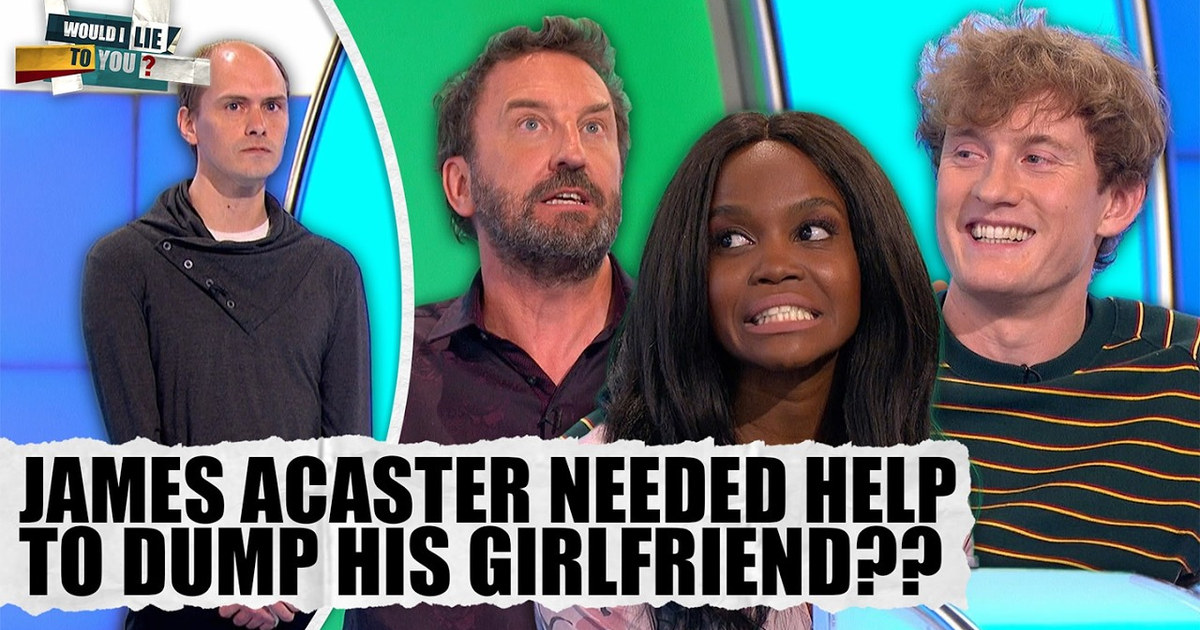
The three claims presented in this specific round are masterpieces of character-driven narrative design. Oti Mabuse, the professional dancer, claims that Jake is her "damaged dancer" from the German version of *Strictly Come Dancing* (*Let's Dance*), whose tooth she accidentally kicked out during a live broadcast. James Acaster, the master of awkward observational comedy, claims Jake is his "breakup buddy" whom he helped write and deliver a teenage breakup letter in a field. Lee Mack, the lightning-fast king of working-class surrealism, claims Jake is his "Frisbee friend" whom he accidentally knocked into an open grave while playing with his son.
For the genre viewer, these three options represent a perfect buffet of narrative flavors. You have the glamorous, high-stakes world of international television (Oti), the painfully relatable cringe of teenage romance (James), and the slapstick absurdity of a graveyard accident (Lee). Each story is perfectly calibrated to the established persona of the storyteller. The game is afoot, and the narrative tension begins to build as the interrogation phase commences.
[[AD]]
The Syntax of James Acaster's Narrative Engine
Let us look under the hood of James Acaster's story, because from a craft perspective, his narrative engine is a marvel of linguistic engineering. Acaster does not tell jokes in the traditional setup-punchline format; instead, he constructs a highly specific, slightly defensive reality and invites the audience to get lost in its parameters. His claim that Jake is his "breakup buddy" is built on a foundation of hyper-specific, mundane details that are incredibly difficult to fabricate on the fly.
When asked why he had to deliver the news of the breakup, James explains, "We wrote a letter together. We were like 15 and it was Jake's first girlfriend and he hadn't got experience of how to break up with people. And to be fair, I had even less." This is a brilliant piece of character initialization. By establishing that both teenagers were operating with zero experience points in the romance department, James immediately makes the absurd premise of a collaborative breakup letter feel entirely logical within the context of teenage awkwardness.
The setting of this collaborative writing session is equally crucial: "We wrote it together in a field." For the craft viewer, the choice of a "field" is a perfect variable. It is empty, isolated, and slightly melancholic—the ultimate environment for two teenage boys to contemplate the mysteries of human relationships. When the panel questions why they were in a field, James replies with a dry, lateral defense: "We went for—we like to go for a lot of walks." It is a line delivered with such flat, unembellished honesty that it bypasses the panel's skepticism entirely.
[[AD]]
The Form Room Delivery and the 'Wild Boy' Variable
The narrative reaches its peak complexity when James describes the delivery of the letter. He did not just help write it; he acted as the courier. "She was in my form," he explains. "So I had to go over to her table and go, 'Oh, this is from Jake.'" The physical layout of the classroom—the "form room"—is mapped out with precise spatial coordinates. We can see the table, the group of girls, and the sudden, catastrophic shift in social dynamics as the letter is opened.


