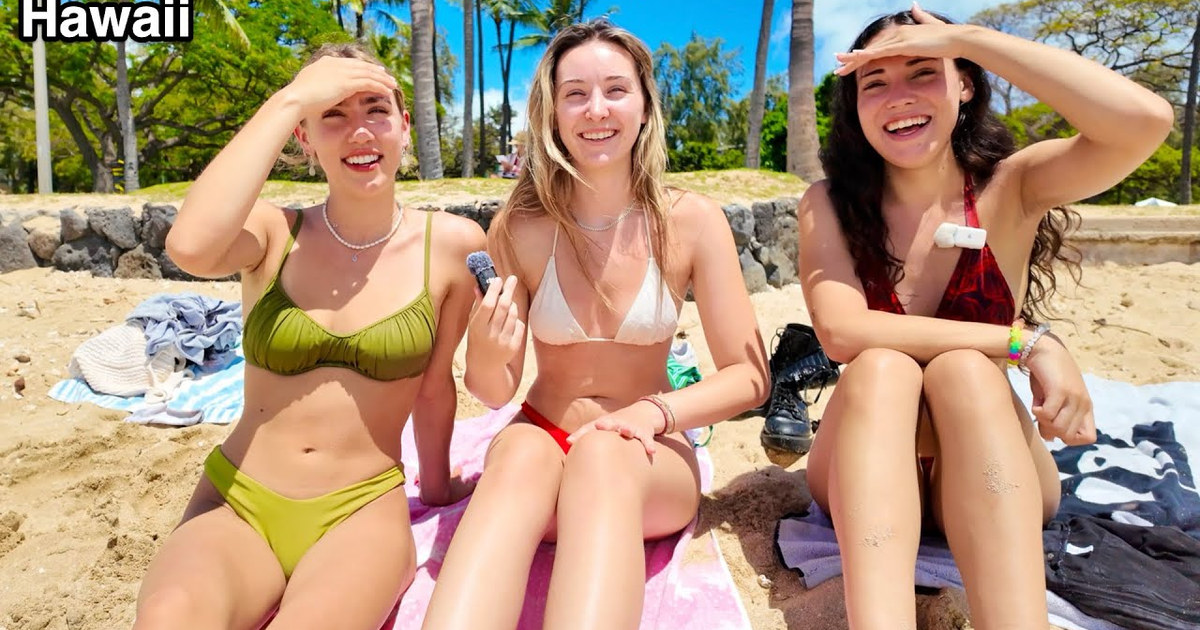
Part 2
Then she explains it, and the explanation is better than the line. Everyone is so friendly. Super talkative. "How are you? How's everything going?" And then the joke with a whole anthropology paper hiding underneath it: "The old guys are nice instead of weird. They're just actually being like, 'How are you? Have fun. Bye.'" That's a comedy beat doing documentary work.
Two more facts get dropped like they're nothing. The public transportation is really good — "especially cuz we don't really have that." And: "The water is warm." That is how you prove a place is worth loving. Not with drone shots. With bus schedules and water temperature.
Then the dating advice, delivered straight down the barrel. "Don't try hard and really be yourself." "Be very friendly. Very authentic." And the closer: "Who cares if you get shut down, because eventually you'll find that one you really click with." That's a close-up. That's the poster frame. Unscripted advice from a stranger hits harder than any monologue a writer could hand an actor, because nobody in it is waiting for coverage to cut.
[[AD]]
And then the kicker, thrown right back at the interviewer: "You look like models." "Thank you. We appreciate it." Flattery on camera is a trust signal. It tells you the two people in frame actually like each other, and that's the one thing you cannot light, rig, or buy.
Born and Raised vs. Tucson, Arizona: Two Speeds, One Island
Beat three opens on a local. "Hi. How are you doing?" "Good, how are you?" "Where are you from?" "I'm from here. Born and raised." "You're local." "Yes." And then, twice, like punctuation: "Aloha. Aloha."
Here's the lesson. Back to back, this video hands you two interviews with the same questions and two completely different rhythms. The tourist talks fast — bright, front-footed, lots of words. The local talks slow. Comfortable with silence. He doesn't rush the answer because he doesn't have to. Same street, same lens, two different movies.
The tourist is the one from Tucson, Arizona, on a little vacation with her mom. She didn't actually pick Hawaii — her mom did, because she's on a work trip meeting with professors on campus. "You are very close to your mom." "Yeah, I am. She's awesome."
[[AD]]
That's a framing problem worth studying. When your subject mentions somebody who isn't in the shot, you have two options. Go wide and let the mom into the frame, or stay tight and let the audience build her in their own heads. Staying tight is almost always the braver call, because it keeps us locked on the face that just softened.
She's been to the other islands — Kauai, the Big Island, Maui — just never Oahu. Favorite beach so far: super clear water, sandy bottom, not too much coral, really nice to swim in. That's a location scout delivered as a compliment, and any DP listening should be scribbling it down.
She's studying psychology at UVA and says she's good at communication because she just likes talking to people honestly. When the interviewer asks for her goal for the year, the answer is "to become financially responsible." Of every answer in this entire video, that's the one the audience will feel in their chest.
Cut to the local. Born and raised. Surfs twice a week — "only," he says, like twice a week is slacking — works at a restaurant in Waikiki, studies geography. Started surfing in eighth grade, took a break, started again during quarantine, stopped, started again. "Off and on for like 10 plus years." Favorite spots: Makapuu Beach, the Northshore, and Waikiki, where he grew up surfing the break. "I grew up in this area so it has a special place in my heart."
[[AD]]
He also just got back from Japan. Tokyo — "amazing." Nagano — "it was cold. Compared to Hawaii." Two lines, one perfect joke, zero edit required. That's what happens when you let a person finish a thought.
His goals for the year: get better at surfing, travel more, keep gardening — flowers and basil — and meet new people. A surfer who grows basil. That's a character, not a type, and it's the exact kind of detail a scripted show would sand off before the table read.
[[VIDEO]]
What to Watch For When You Rewatch It
Watch the greeting. The same four words, every single time — "Hello. How are you doing?" Then watch how fast the strangers' shoulders drop. That drop is the shot. Everything after it is just talking.
Watch the exposure. Every time the interviewer slides into open shade, the background stops clipping and the face starts doing the talking. That's the entire difference between a snapshot and a portrait, and it costs nothing but a step to the left.
Watch who holds the pause. "Culture pleased" takes a beat to arrive, and that beat is why you'll remember it. The interviews that feel slow are the ones that stick.
Watch the jokes land: "You are rich, I guess." "The water is warm." "Old guys are nice instead of weird." "I waddle in the water." Every one of them is doing character work while pretending to be nothing at all.
Here's the takeaway. The gear isn't the movie. The permission is. Somebody walked up to strangers on a beautiful island, asked sincere questions, and then had the discipline to hold the frame and let the answers breathe. You can do that with the phone in your pocket and a free afternoon. The aloha is optional. The holding is not.
And that's why this one keeps pulling people back. Next time, we're breaking down what happens when the exact same walk-up format runs into a subject who doesn't want to talk — because that's where the real cinematography starts.


