Part 1
You can shoot cinematic portraiture with one camera, one lens, and the sun — and this Hawaii street interview is the loudest proof you'll see this year.
I've spent years in second unit, which is the corner of filmmaking where you learn what a lighting package actually costs. A 4x4 silver bounce. A couple of tube lights. A gaffer. A grip. An AC pulling focus. A producer tapping her watch. This video has none of that. It has a beach, a walk-up, and strangers who say yes.
The format is almost insultingly simple. A filmmaker walks up to people in Hawaii and asks the kind of questions that don't sound like questions. Where are you from? What do you do? What's your favorite place here? That's it. No set, no rigging, no budget line for lighting — just aloha, small talk, and the Pacific doing free work in the background.
[[AD]]
And it opens on a loop. "Hello. How are you doing? Good morning." Then again. Then again. The same four words, over and over, until they stop feeling like dialogue and start feeling like a downbeat.
That is not lazy editing. That is a metronome. In an interview doc, the first ten seconds have to train the audience to relax, and repetition does that faster than any title card ever will. Twenty-four frames a second is just repetition, too. Same idea, different medium.
So here's the argument I want to make, and I'll defend it in three beats. One: the California trio, where sand becomes the biggest bounce card on the island. Two: the answer "I was culture pleased" — a throwaway line that quietly turns into the thesis of the whole piece. Three: the born-and-raised local who stands next to a college tourist and shows you two completely different films shot on the same street.
The Greeting Loop: How Sand and Sunlight Out-Light a Full Crew
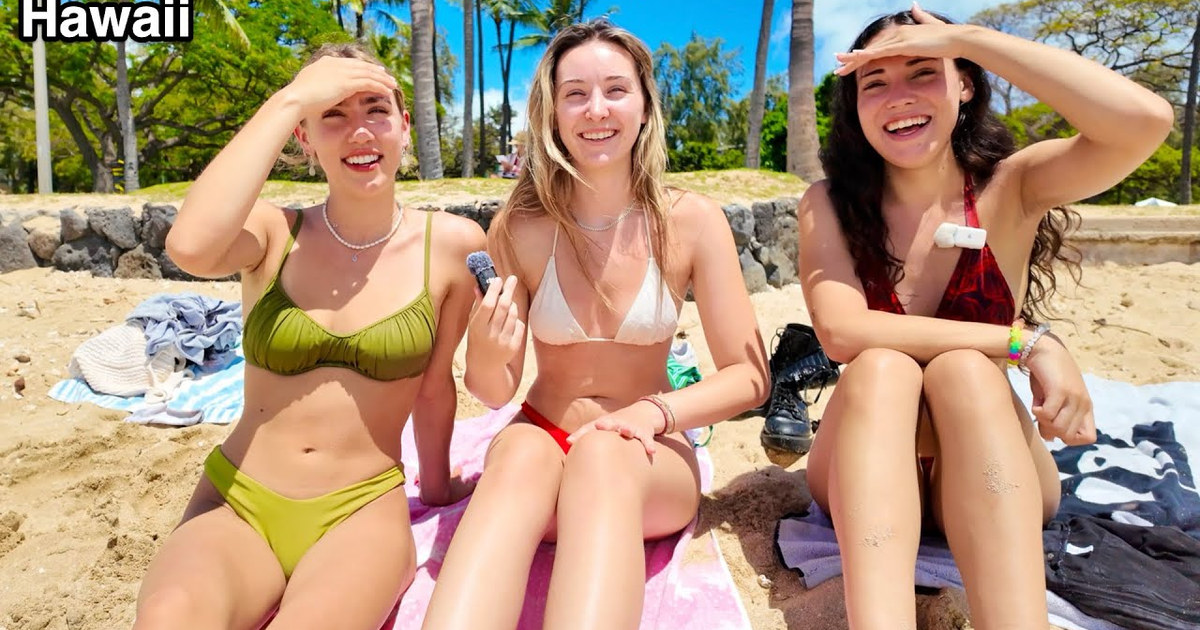
Beat one starts hot. "Where are you from?" — "California." Six times it lands before the question even finishes. Santa Monica. Laguna Beach. Orange County. Southern California, all sunshine and teeth, standing on the sidewalk answering like they've been waiting all day for somebody to ask.
"You are rich, I guess." "Very rich." "Maybe. No, not me. Not personally." Then: "We'll go with it." And the laugh. That's the entire beat, three seconds long, and it buys you more character than a page of backstory. This is why you keep rolling after the answer and not just during it.
[[AD]]
Now the craft lesson. White sand and pale concrete are the largest bounce cards on earth. They throw light back up into a face from underneath at an angle most DPs would pay real money for. Drop to around f/2.8 on an 85, let the background melt into warm marble, and a face lit by nothing but Hawaii reads like it's sitting on a two-thousand-dollar HMI. The gaffer here is the ocean.
Then the answers get specific, which is what separates a real street interview from a bit. One is a manager. One works at a coffee shop. One works at a sushi bar. One works a breakfast diner and is in college. "I'm just a college student right now." Nobody is performing a job title for a résumé. They're just telling you where they clock in, and that honesty is the texture of the whole thing.
And there's a clock. "How long is your stay in Hawaii?" — "We got seven more hours or so. This is our last day. We've been here a week." Seven hours. Every scene needs a ticking clock, and this one is loud enough to make a sunset feel like a deadline. "I cried watching the sunset yesterday." She says it flat, like a fact, which is exactly how you say the truest thing in the room.
Then the day that made the trip. The Northshore. A rented convertible. "We went around the whole island. 100% recommend. That was like the best day ever." And when the surfing question comes, the trio splits clean down the middle: one actually surfs, one waddles in the water and gets knocked down by the waves. That's the entire spectrum of vacation in a single frame.
"I Was Culture Pleased": The Line That Rewrites the Whole Video
Beat two opens on a question that usually gets a shrug. "Have you faced any culture shock in Hawaii?" Pause. "Culture shock?" Another pause. You can feel the whole frame searching for an answer it doesn't have yet.
"I wouldn't say I was culture shocked, but I was culture pleased." That's it. That's the line the whole video is secretly about, and it lands like an accident. I've watched a mountain of travel content and I've never heard anybody flip that question like that. It isn't a joke. It's a thesis. The island didn't confuse her — it charmed her.
Here's the technical version of the same point. When a subject hands you a line like that, you do not move the camera. No slow push. No snap zoom. No cutaway to the ocean. You hold, you let the silence sit, and you let the audience decide when to laugh. Camera movement tells people how to feel. Stillness lets them figure it out — and on a line like "culture pleased," stillness is the entire gift.
[[AD]]


