Part 2
Yvonne chose to remain single from 1958 onward, framing that four-decade autonomy not as an absence of romance, but as the ultimate fertile ground for self-discovery. By stepping away from the traditional domestic scripts of the mid-twentieth century, she bought herself the freedom to discover her own interior landscape without having to compromise her peace or subordinate her spirit to someone else's demands.
Her relationship with her son Larry, who was fifty years old at the time of the taping, carries its own delightfully subversive punchline. When the two of them venture out into the city together, bystanders routinely assume Larry is her romantic date. It is a detail she shares with a knowing smile—a humorous testament to how thoroughly she has broken the conventional visual cues of generational time.
[[AD]]
Transcendental Meditation and the Inner Flame
Central to Yvonne’s internal reconstruction was her early introduction to Transcendental Meditation. She speaks of TM not as a trendy lifestyle accessory, but as the technology that unlocked what she calls her 'inner bliss.' By carving out silence every day, she established a fortress of tranquility that shielded her nervous system from the corrosive micro-stresses of modern existence.
She describes this practice as creating a 'high life condition'—a term echoing philosophical systems that view human vitality as an energetic frequency rather than a finite biological countdown. Once that internal switch was flicked, as she puts it, everything in her journey has been 'up, up, up.' Passion and joy ceased to be fleeting reactions to external luck; they became baseline environmental conditions she cultivated intentionally.
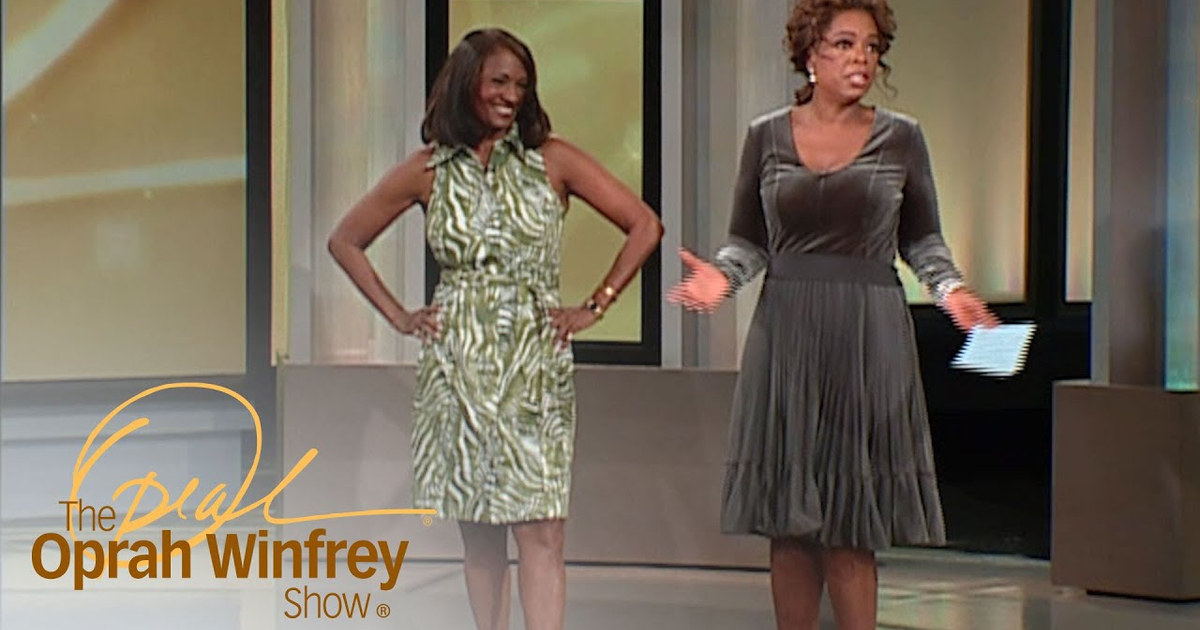
Oprah connects Yvonne’s journey with another guest from the same episode, Elaine, who found her transformation through the disciplined martial art of Taekwondo. The thematic symmetry strikes Oprah with the force of an on-air revelation. The host pauses, stepping outside the typical format of daytime beauty segments to deliver an impassioned critique of modern living.
[[AD]]
The Architecture of Joy: Oprah's On-Air Epiphany
Oprah’s epiphany crystallizes on camera in real time: misery is the ultimate ager. Bad marriages that extinguish your dignity, deadening jobs that drain your nervous system, toxic dynamics that keep you locked in constant fight-or-flight—these are not merely emotional burdens. They are physical toxins that carve themselves directly into human flesh. The face, Oprah realizes, is an open-source diary of every compromise you have ever made.
When you live in passion and alignment, your cellular environment changes. Yvonne Swann is living proof that beauty isn't an accidental lottery ticket won at birth and slowly lost to entropy; it is the visible aftermath of decisions made in private over thousands of consecutive mornings. By refusing to inhabit misery, Yvonne avoided the invisible wear and tear that ages most people long before their bodies do.
Her dietary philosophy mirrors this lack of neurosis. Yvonne describes eating sensibly without ascetic misery: if she indulges in dessert one evening, she simply skips it the next. She savors a martini or a glass of wine with dinner, completely rejecting the punishing extremes of modern wellness culture. There is no moralizing around bread or spirits; there is only harmony, presence, and balance.
[[AD]]
The Ritual of Moisture: Skin as Canvas and Shield
And then comes the practical gospel, delivered with absolute conviction. Before the segment winds down, Yvonne leans into the microphone to deliver her golden rule: 'Moisturize, moisturize, moisturize.' This is not a superficial vanity tip; it is a sacred morning liturgy that precedes even the outside world.
She tells Oprah that every single morning, before she even opens her front door to collect her copy of The New York Times, she has already covered her entire body in moisturizer. Think about the poetic rhythm of that sequence: before taking in the news of wars, political conflicts, financial crises, and human grief delivered in black ink, she coats herself in protection. She prepares her skin before she accepts the world.
She doesn't wear makeup daily. Her skin doesn't need to hide behind heavy foundations or color correctors. Instead, she maintains hydration as a foundational boundary. Oprah plays the comedic straight woman to perfection, throwing her hands in the air and declaring, 'Okay, well if that's the key, then let's go buy the moisturizer!'—the audience roaring with ecstatic approval.
[[VIDEO]]
Why Yvonne Swann Still Matters in the Digital Age
Years after this broadcast, the clip continues to circulate endlessly across TikTok, Instagram Reels, and YouTube shorts, regularly going viral among younger generations who were not even born when Yvonne made her decision in 1958. In an era saturated with injectables, preventative botox, filtered lenses, and fourteen-step algorithmic skincare routines, Yvonne Swann represents an organic vitality that money cannot purchase at a medical spa.
The modern viewer watches Yvonne and senses an authenticity that defies modern digital artifice. She doesn't have the frozen, symmetrical immobility of contemporary aesthetic treatments; her face moves with laughter, her eyes sparkle with authentic curiosity, and her neck and shoulders radiate genuine physical power. Her youthfulness isn't a performance for a camera; it is the natural byproduct of a life lived without regret.
Yvonne dismantled the patronizing narrative that older women become invisible. At seventy, she felt more beautiful, more confident, and more adventurous than she had at sixty, fifty, or forty. She reminds us that the second half of life does not have to be a slow retreat into the background. It can be an expansion, a sustained crescendo, a continuous opening of the self toward the world.
[[AD]]
Returning to the Bottom of the Stairs
Look back once more at that opening freeze frame: Yvonne Swann stepping down the Harpo Studios staircase toward Oprah Winfrey. When you first witness that moment, you see only the illusion of youth—a striking seventy-year-old woman who could pass for someone half her age, an astonishing genetic triumph that defies the laws of nature.
But once you know her story, the image changes completely. You no longer see an accidental anomaly or a lucky beneficiary of good genes. You see a twenty-one-year-old single mother in 1958 who looked out at the bleak landscape of what society expected from her and chose, with fierce intentionality, to raise herself again from scratch.
You see the bicycle tracks cutting through the chill of autumn in Manhattan; you hear the meditative hum of a quiet room at dawn; you smell the clean moisturizer applied before the newspaper brings the noise of the universe onto the doorstep. Yvonne Swann didn't cheat time—she outloved it. She proved that when you refuse to let misery take root inside your bones, the world becomes an oyster that never stops opening.


