Part 1
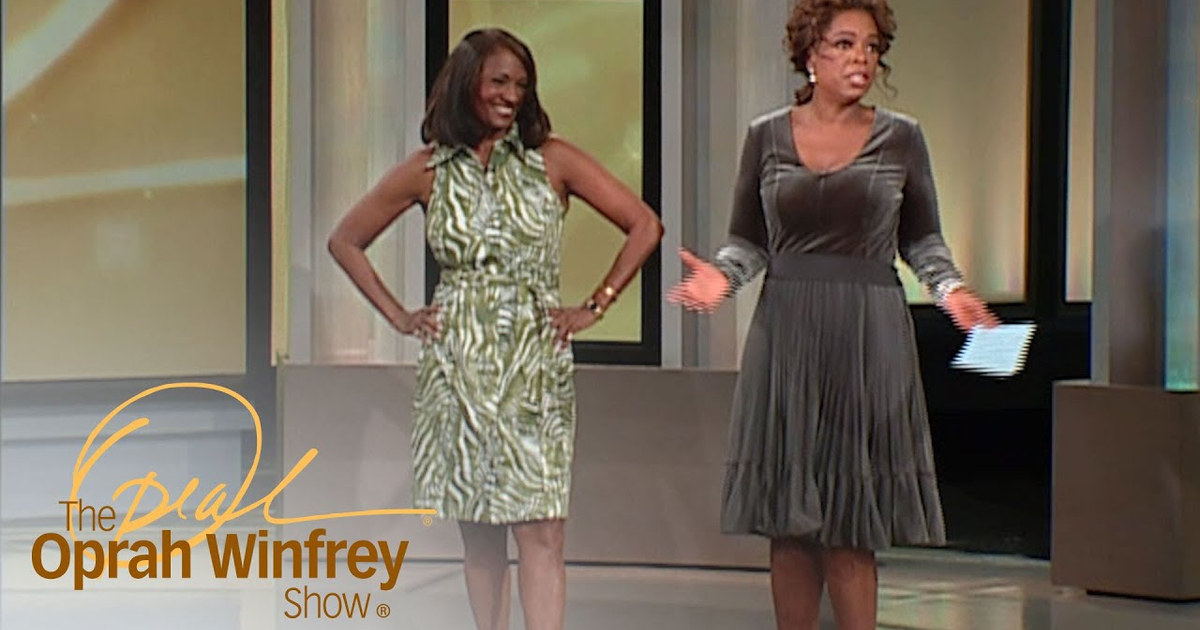
Before the studio audience erupts into applause, there is the suspension of a single breath as Yvonne Swann walks down the polished stairs under the warm studio lights of Harpo Studios in 2007. Oprah Winfrey stands at the bottom of that stage, leaning forward on the balls of her feet, her hands gesturing wide, trying to decipher the impossible geometry of a woman whose face refuses every chronological category. The studio monitors capture a silhouette so buoyant, so untethered to the gravity of common reckoning, that for a split second the air leaves the room. Oprah’s eyes widen in genuine theatrical disbelief as she throws out numbers like wild cards tossed onto a table: thirty-five, sixty-five, a total mystery wrapped in radiant bronze skin.
The immediate context is peak daytime television drama, the gold standard of syndicated spectacle where Oprah turned ordinary domestic encounters into transformative cultural sermons. This particular segment, cut from a classic 2007 episode celebrating women defying biological expectations alongside the cultural backdrop of Dove’s Campaign for Real Beauty, was supposed to be a standard aesthetic reveal. Instead, it became something far more astonishing: an unscripted philosophical treatise on living entirely on one’s own terms. When Yvonne steps onto the main floor, smiling with the unhurried grace of someone who possesses an infinite afternoon, she isn't just presenting a youthful face; she is bringing seven full decades of lived experience into sharp, electrifying focus.
Television in the mid-2000s thrived on transformation, but daytime programming usually measured makeovers through external modifications—the snip of a scissor, the tuck of a dress, or the clinical edge of a scalpel. Here, the lens captures an entirely different kind of transmutation. Yvonne Swann arrives not as a makeover recipient, but as a living monument to self-architecture, leaving the audience and the host scrambling to recalibrate their understanding of human time.
[[AD]]
The Studio Stage as an Altar of Unbelief
Consider the rhythmic choreography of Oprah’s interrogation. The host does not merely ask Yvonne for her age; she treats the mystery as an interactive puzzle for millions of viewers at home. Oprah jokes about the melanin phenomenon—the familiar aphorism that 'Black don't crack'—framing the revelation within shared cultural vernacular before detonating the real figure. Yvonne announces that she is seventy years old. Oprah’s voice drops into staccato repetition, chanting 'Seven-oh. Seven-oh. Seven-oh,' testing the syllables against her tongue as if trying to locate a hidden seam in a counterfeited garment.
Yvonne responds with pure poise: 'That's what it looks like in 2007.' In six short syllables, she turns what could have been a defensive defense of age into a bold manifesto. She refuses to apologize for the decades or perform the nervous self-deprecation that daytime television so often coaxes out of women. Her voice carries the easy timbre of someone who has nothing left to negotiate with the world.
The cameras pan across the audience, lingering on faces slack-jawed with admiration and disbelief. Even the women featured in the nearby Dove campaign, seated in their pristine white robes and chosen specifically for their unapologetic realness, look transfixed. The visual architecture of the stage shifts from a standard interview format into an impromptu revival hall where vitality is the gospel being preached.
[[AD]]
The NYC Blueprint: Movement as Daily Architecture
When the pre-taped package rolls, the viewer is transported into Yvonne’s everyday existence in New York City, and the imagery reads like a kinetic love letter to urban mobility. Yvonne describes descending from her apartment straight into the beating heart of Manhattan. There are no private cars, no hermetically sealed transit bubbles isolating her from the world. Her transportation is elemental: walking, pedaling a bicycle through traffic, and gliding on rollerblades across asphalt.
Every shot of Yvonne moving through New York feels intentional and fully present. She treats the city streets not as an obstacle course to endure, but as a sprawling outdoor gym and theater. To choose a bicycle and rollerblades in your late sixties and seventies is an act of bodily defiance, rejecting the societal script that demands older women retreat indoors into cushioned stillness. Her stride possesses rhythm; her posture reflects a lifelong dialogue with balance and momentum.
When the weather outside turns sour, she does not surrender to inertia. Inside her home, the camera reveals a Pilates bench and a stack of belly dance instructional tapes. Several times a week, she dances alone in her living room, undulating her spine and engaging core musculature with theatrical joy. This is physical engagement stripped of corporate punishment—it is movement conceived as pleasure, rhythm, and self-celebration.
[[AD]]
The Radical Turn: Re-Raising Yourself at Twenty-One
Yet the physical kineticism of Yvonne’s daily routine only scratches the surface. When Oprah presses her for the core secret, the root philosophy powering this incandescent exterior, Yvonne points back to a decisive moment five decades earlier. In 1958, at the age of twenty-one, she found herself navigating a divorce and raising her infant son, Larry. Rather than collapsing under social stigma or familiar patterns, she made an astonishing psychological pivot.
She decided, in her own piercing phrasing, to 're-raise' herself. That specific formulation stops Oprah in her tracks, prompting a spontaneous 'Thank you, mama' from the host. To re-raise oneself is a radical artistic act of self-authorship. It means surveying the inherited blueprint of your childhood, identifying every crack, limitation, and sorrow, and deciding to demolish the foundation in order to build something entirely original from the ground up.


